KNOWLEDGE SUCCESS
Young People with Disabilities: Ensuring Inclusive Access to SRH Services
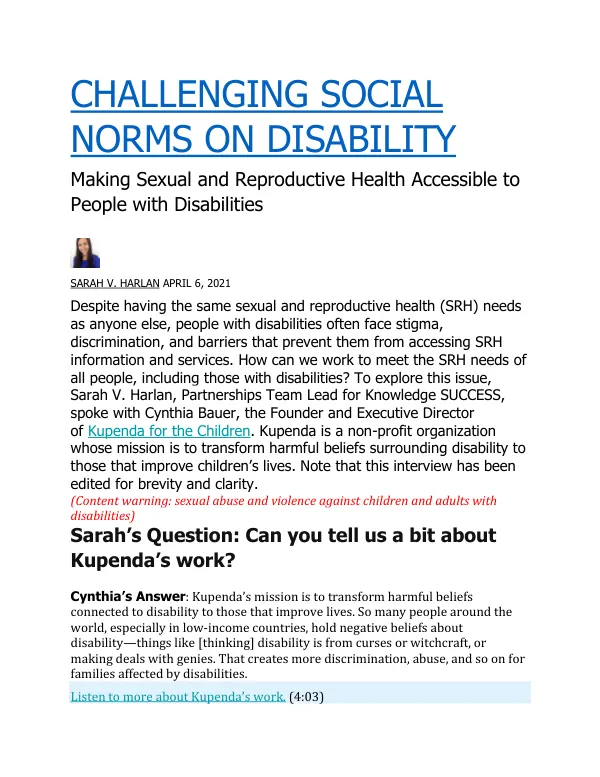
The discussion on ensuring inclusive access to sexual and reproductive health (SRH) services for young people with disabilities began with a focus on the stigmatization of young people with disabilities and its impact on access to SRH services.
2021 · 7 pages
Sign in to readA free account is required to download.
Abstract
Cynthia R. Bauer, Founder and Executive Director of Kupenda for the Children, highlighted the organization's efforts to transform harmful beliefs connected to disability and improve the lives of children with disabilities. She emphasized the importance of removing superficial beliefs surrounding disabilities that are passed along in some communities. Zekia Musa Ahmed, a Humanities & Inclusion consultant, discussed the many sociocultural considerations for those with disabilities. She noted that various factors, such as age, setting (urban vs. rural), and the type of disability, may influence the way a person experiences their disability and how that person is perceived by others. Leyla Sharafi, Senior Gender Advisor and Focal Point for Disabilities at UNFPA, offered a global perspective, stating that the young people she has worked with around the world come to mind, highlighting diversity in terms of region, gender, age, and ability. To promote inclusivity in SRH programs, Ms. Ahmed suggested that hospitals and other health facilities should be physically accessible to those with disabilities, with features such as ramps, Braille translation, and sign language interpreters. She also emphasized the importance of coordination with organizations of persons with disabilities (OPDs) and service providers to sort out misconceptions regarding family planning. Ms. Bauer discussed the role of accessible education in promoting inclusion, highlighting the need to ensure that children with disabilities are able to access education, as only 10% of children around the world with disabilities are able to do so. Ms. Sharafi spoke about the importance of an enabling legislative environment, quality services, and changing perceptions to promote inclusivity. She helped develop guidelines with Women Enabled International for considerations to take when developing services. Additionally, family planning programs and the monitoring of services need to be robust, and it is essential to consider the mindsets, perceptions, and misconceptions that even health care providers have with regard to young people with disabilities. To address stigma surrounding young people with disabilities accessing SRH services, there are guidelines and information available, such as the AAAQ framework (availability, acceptability, accessibility, and quality). However, investment from government and policy makers is crucial. Ms. Sharafi emphasized the importance of adjusting existing services, as services for persons with disabilities don't need to stand alone. Involving people with disabilities and receiving their inputs is essential for both adjusting and creating new programs that are the most effective. Ms. Ahmed stressed the importance of improving coordination between OPDs and service providers and having a clear referral system procedure so persons with disabilities can more easily access SRH services. She also spoke about the importance of involving people with disabilities when improving inclusivity in existing programs and creating new programs. It is essential to reduce barriers so that people with disabilities can play an active role in such initiatives. Lastly, it is essential to collect data on the involvement of individuals with disabilities in these projects. The discussion also highlighted the importance of humanizing people with disabilities, educating people about the humanization of people with disabilities, and addressing the structural components in society that create barriers and generate stigma around people living with disabilities. Educating faith leaders, school teachers, government representatives, and others about the humanization of people with disabilities is essential to address these barriers. Involving people with disabilities in programs and services is crucial to ensure that their needs are met and that they are able to access SRH services. Ms. Ahmed emphasized the importance of actively involving OPDs and collaborating between disability organizations and organizations not focused on disabilities. Ms. Bauer encouraged people to look around the programs they are involved in and ask if people with disabilities are being included—and if not, ask why not. She also discussed how it is difficult to generalize disabilities as they come in many forms, and it is thus essential to speak to the importance of including those living with disabilities at every table.