EAST WEST MANAGEMENT INSTITUTE, INC.
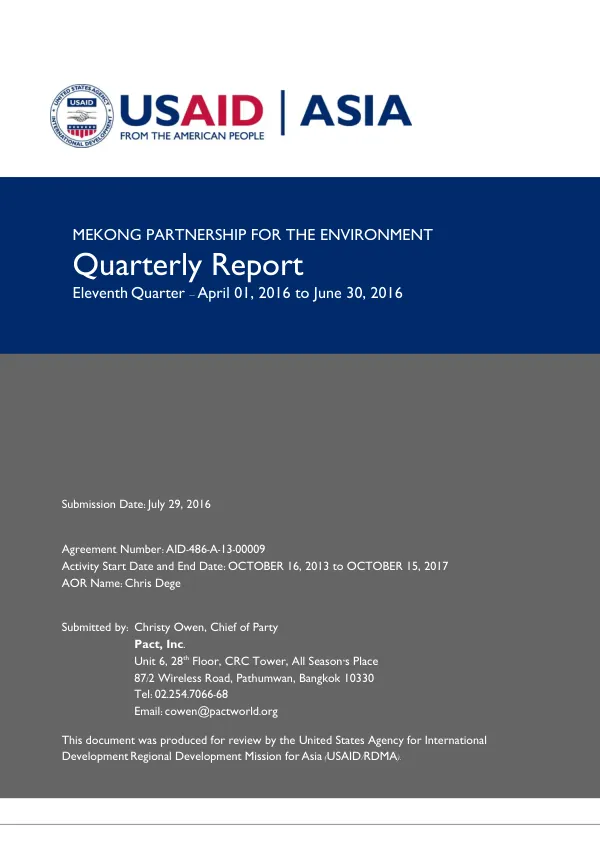
Eleventh Quarterly Report: Mekong Partnership for the Environment
The Mekong Partnership for the Environment (MPE) project aims to advance informed multi-stakeholder dialogues on the social and environmental costs and benefits of regional development projects.
2016 · 65 pages
Sign in to readA free account is required to download.
Abstract
The project was awarded a four-year $13 million cooperative agreement by the United States Agency for International Development (USAID) / Regional Development Mission for Asia (RDMA) to Pact, Inc. in partnership with East-West Management Institute (EWMI), Internews, Stockholm Environment Institute (SEI), and Wildlife Conservation Society (WCS). The project has an end date of October 15, 2017. The goal of MPE is to increase capacity of civil society to influence development decisions that have significant anticipated social and environmental impacts. To achieve this goal, the project has three objectives: 1) increase capacity of civil society to influence development decisions, 2) strengthen regional platforms for multi-stakeholder participation in development decision-making, and 3) increase public access to quality, timely information on environmental and social costs and benefits of development projects. During the eleventh quarter (April-June 2016), a number of key activities were implemented. The "Communicating for Change" series was completed, which included a final workshop that increased participants' understanding of strategic communications principles. This will lead to better communication strategies, particularly in promoting meaningful public participation within the Mekong region. A regional communication and advocacy plan was developed, which will be implemented with MPE support. Additionally, Pact awarded seven new CSO grants in the reporting period, with two projects each in Cambodia, Myanmar, and Vietnam, and one project from Thailand. These grants aim to increase the capacity of civil society organizations to influence development decisions and promote meaningful public participation. The MPE project also expanded and advanced the multi-stakeholder regional dialogue on public participation. In Quarter 11, the first full regional dialogue was held, which brought together stakeholders from the Lower Mekong countries to discuss public participation in development projects. The dialogue aimed to increase public access to quality, timely information on environmental and social costs and benefits of development projects. The project has made significant progress in achieving its objectives. The regional network of civil society organizations has been established and strengthened, and at least two CSOs in each of the Lower Mekong countries have increased specialized expertise and capacity to engage in regional policy and project level dialogues. Stakeholders in the Lower Mekong countries have increased access to relevant and timely information on the environmental and social costs and benefits of regional development projects. The project has also influenced at least three specific regional development projects through multi-stakeholder dialogues and/or civil society input. Additionally, at least two civil society partner organizations will be eligible to receive direct USAID funds in year three of the project. The project has made significant progress in achieving its objectives and will continue to work towards its goal of advancing informed multi-stakeholder dialogues on the social and environmental costs and benefits of regional development projects. The MPE project has a geographic coverage of Burma, Cambodia, Laos, Thailand, Vietnam, and China. The project has a reporting period of April 1, 2016, to June 30, 2016. The project has a number of major counterpart organizations, including the Ministry of Environment, the Asian Environmental Compliance and Enforcement Network, and the Stockholm Environment Institute. The project has also established a number of partnerships with local organizations, including the Cambodia Development Resource Institute, the Center for Environment and Community Assets Development, and the Community Resource Center. The project has a number of sub-awardees, including East West Management Institute, Internews, Stockholm Environment Institute, and Wildlife Conservation Society. The project has a number of key activities planned for the next reporting period, including the implementation of the regional communication and advocacy plan, the continuation of the CSO Regional Network, and the expansion of the multi-stakeholder regional dialogue on public participation. The project will continue to work towards its goal of advancing informed multi-stakeholder dialogues on the social and environmental costs and benefits of regional development projects.