EAST WEST MANAGEMENT INSTITUTE, INC.
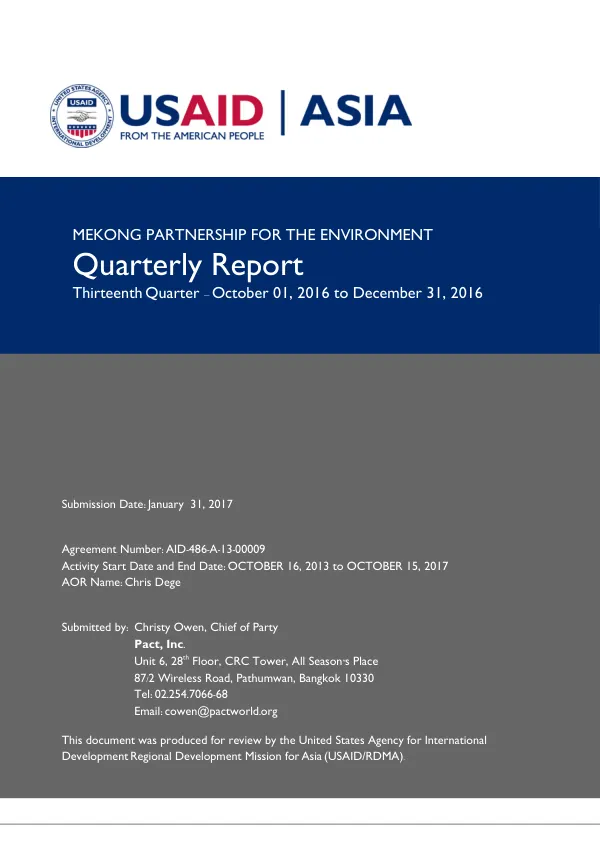
Thirteenth Quarterly Report: Mekong Partnership for the Environment
The Mekong Partnership for the Environment (MPE) project aims to advance informed multi-stakeholder dialogues on the social and environmental costs and benefits of regional development projects.
2017 · 40 pages
Sign in to readA free account is required to download.
Abstract
The project was awarded a four-year $13 million cooperative agreement by the United States Agency for International Development (USAID)/Regional Development Mission for Asia (RDMA) to Pact, Inc. in partnership with East-West Management Institute (EWMI), Internews, Stockholm Environment Institute (SEI), and Wildlife Conservation Society (WCS). The project has an end date of October 15, 2017. The goal of MPE is to increase capacity of civil society to influence development decisions that have significant anticipated social and environmental impacts. To achieve this goal, the project has three objectives: 1) increase capacity of civil society to influence development decisions, 2) strengthen regional platforms for multi-stakeholder participation in development decision-making, and 3) increase public access to quality, timely information on environmental and social costs and benefits of development projects. During the thirteenth quarter, which spans from October 1, 2016 to December 31, 2016, several key events occurred. Six public consultations were held on the draft Regional Guidelines on Public Participation in Environmental Impact Assessment (EIA). The draft guidelines were made available for public comment from August 22 to October 31, 2016, and national consultation meetings were held across the region during October to solicit feedback and comments from government agencies, NGOs, project proponents, EIA consulting firms, academics, and other interested stakeholders. The consultation meetings were held in Hanoi, Ho Chi Minh City, and Yangon, and were attended by various stakeholders. The draft guidelines were developed in consultation with the Asian Environmental Compliance and Enforcement Network (AECEN) and the Stockholm Environment Institute (SEI). The guidelines aim to provide a framework for public participation in EIA, and are expected to contribute to the development of a regional EIA system. The MPE project has made significant progress in increasing the capacity of civil society organizations (CSOs) to engage in regional policy and project-level dialogues. At least two CSOs in each of the Lower Mekong countries have increased specialized expertise and capacity to engage in regional policy and project-level dialogues. CSOs are also able to effectively gather, formulate, and communicate local perspectives on regional development projects to policy-makers. The project has also increased public access to relevant and timely information on the environmental and social costs and benefits of regional development projects. Stakeholders in the Lower Mekong countries have increased access to information on the environmental and social costs and benefits of regional development projects. At least three specific regional development projects have been influenced by multi-stakeholder dialogues and/or civil society input. The MPE project has also made progress in strengthening regional platforms for multi-stakeholder participation in development decision-making. Regional networks of CSOs focused on social and environmental safeguards have been established and/or strengthened. The project has also increased the capacity of CSOs to engage in regional policy and project-level dialogues. The project has also made progress in increasing public access to quality, timely information on environmental and social costs and benefits of development projects. The project has developed a regional EIA system, which aims to provide a framework for public participation in EIA. The project has also increased the capacity of CSOs to gather, formulate, and communicate local perspectives on regional development projects to policy-makers. The MPE project has also made progress in increasing the capacity of CSOs to engage in regional policy and project-level dialogues. At least two CSOs in each of
Related documents