CLOUDBURST CONSULTING GROUP, INC.
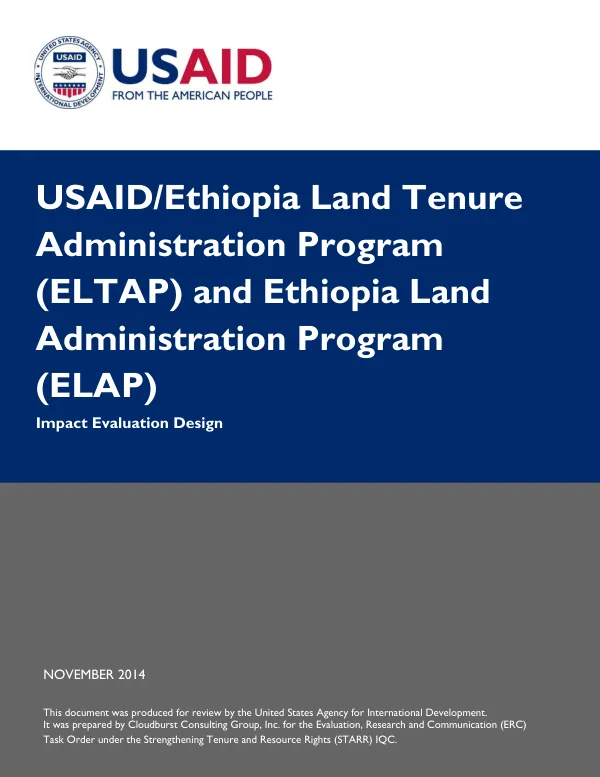
ELTAP/ELTAP Impact Evaluation Design Report
The Ethiopia Land Tenure Administration Program (ELTAP) and the Ethiopia Land Administration Program (ELAP) were initiated by the Government of Ethiopia (GoE) to increase tenure security and certify long-term use rights for rural households.
2014 · 37 pages
Sign in to readA free account is required to download.
Abstract
Following decades of insecurity, the GoE embarked on a program to document and register lands held by rural households. The first level land certification program has been successful in increasing economic outcomes, but it had shortcomings that prevented it from being a viable long-term solution. To address these issues, USAID began working with the GoE to support second level land certification starting with ELTAP (2005-2008) and continuing under ELAP (2008-2013). Second level land certification involves the use of handheld GPS devices to map and demarcate parcel boundaries, a key component of land administration systems that was not part of the first level activities. The GoE plans to scale up second level certification using its own resources and support from development partners. The evaluation will focus on measuring the impact of second level land certification in comparison to first level land certification, which has already reached the majority of rural smallholders in the Highland regions. The overarching question that underlies and motivates this evaluation is: "Does second level land certification marginally increase tenure security and improve rural livelihoods as compared to first level land certification?" A number of ancillary questions help frame the broader policy discussion and inform a range of land tenure issues. These questions include: Does the added expense of second level land certification provide additional land tenure security benefits at least equal to the difference in cost between the two certification methodologies? How, if at all, have first level vs. second level land certificates been used as proof of ownership (e.g. for obtaining micro-loans, resolving land disputes, or resolving challenges to their land claim)? The evaluation will be conducted under the Evaluation, Research, and Communications (ERC) Task Order # AID-OAA-TO-13-00019 for USAID. The research will involve a literature review and theoretical framework, as well as a sampling and identification strategy. The evaluation will also involve survey and management, including the use of survey instruments, household survey, community key informant, and Woreda land administration office survey. The evaluation will provide information on the impact of second level land certification in comparison to first level land certification, which will help inform future policy and answer the question "how secure is secure enough?" The evaluation will also provide information on the use of first level vs. second level land certificates as proof of ownership, which will help inform a range of land tenure issues. The evaluation will be conducted in the Highland regions of Ethiopia, where first level land certification has already reached the majority of rural smallholders. The evaluation will involve a comparison of the impact of second level land certification with first level land certification, which will provide information on the effectiveness of second level land certification in increasing tenure security and improving rural livelihoods. The evaluation will also provide information on the cost-effectiveness of second level land certification compared to first level certification, which will help inform future policy and resource allocation. The evaluation will involve a comparison of the marginal benefits of second level certification with the marginal costs, which will provide information on the cost-effectiveness of second level land certification.