BANK FOR WEST AFRICAN DEVELOPMENT
Ethiopia Energy Sector Overview
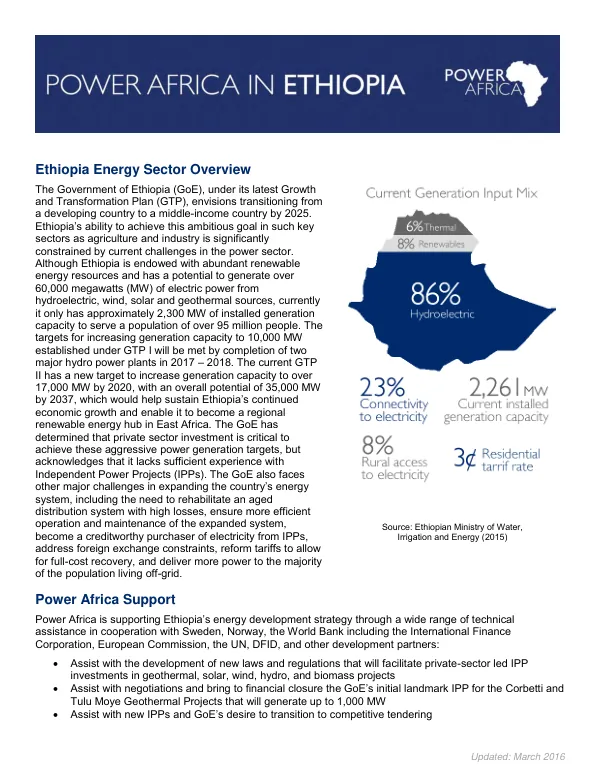
The Government of Ethiopia (GoE) has set ambitious goals for the country's energy sector, with a vision to transition from a developing country to a middle-income country by 2025.
2016 · 2 pages
Sign in to readA free account is required to download.
Abstract
The current Growth and Transformation Plan (GTP) II aims to increase the country's installed generation capacity to over 17,000 megawatts (MW) by 2020, with an overall potential of 35,000 MW by 2037. This would enable Ethiopia to become a regional renewable energy hub in East Africa and sustain the country's continued economic growth. The GoE faces significant challenges in expanding the country's energy system, including the need to rehabilitate an aged distribution system with high losses, ensure more efficient operation and maintenance of the expanded system, and become a creditworthy purchaser of electricity from Independent Power Projects (IPPs). To address these challenges, the GoE has determined that private sector investment is critical, but acknowledges that it lacks sufficient experience with IPPs. The GoE also needs to reform tariffs to allow for full-cost recovery, address foreign exchange constraints, and deliver more power to the majority of the population living off-grid. Power Africa is supporting Ethiopia's energy development strategy through a wide range of technical assistance, in cooperation with Sweden, Norway, the World Bank, the European Commission, the UN, DFID, and other development partners. Power Africa is assisting with the development of new laws and regulations that will facilitate private-sector led IPP investments in geothermal, solar, wind, hydro, and biomass projects. The initiative is also supporting the GoE's initial landmark IPP for the Corbetti and Tulu Moye Geothermal Projects, which will generate up to 1,000 MW. Power Africa is providing technical assistance in several key areas, including the planning, operation, and maintenance of generation, transmission, and distribution systems as they are expanded. The initiative is also developing the grid code that specifies the rules and responsibilities for all energy stakeholders, and developing a plan to reduce distribution losses and assist with the introduction of "smart grid technology." Additionally, Power Africa is supporting access to off-grid electricity and strengthening the Ethiopian Electricity Authority to perform as an effective regulator. The Eastern Africa Power Pool (EAPP), based in Ethiopia, is also receiving support from Power Africa. The EAPP is mandated to facilitate cross-border trading of renewable energy at the lowest possible cost and efficiently manage a regionally integrated system. Power Africa support includes the development of common codes for the regional network, tracking interconnecting transmission lines, and training for EAPP and member countries to analyze and operate the regional power system.
Related documents