USAID DEC
EMERGENCY ELECTRIC POWER RESTORATION FOR THE DOMINICAN REPUBLIC - FINAL EVALUATION REPORT DISTRIBUTION MATERIAL
Sign inCHARLES T. MAIN INTERNATIONAL, INC.
EMERGENCY ELECTRIC POWER RESTORATION FOR THE DOMINICAN REPUBLIC - FINAL EVALUATION REPORT DISTRIBUTION MATERIAL
Evaluates project to repair the electrical distribution systems destroyed by Hurricane David in the three Dominican Republic cities of Haina, San Cristobal, and Bani.
1980
Sign in to readA free account is required to download.
Abstract
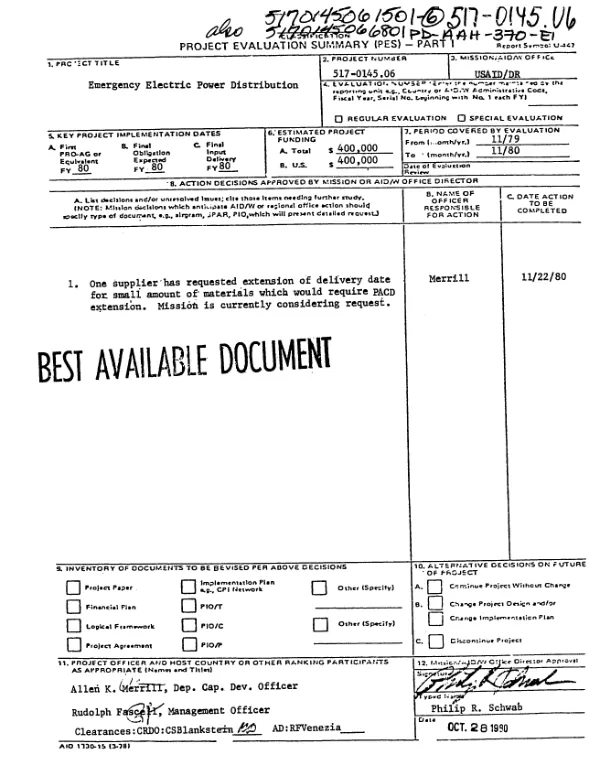
This final evaluation, which is attached to a PES of 10/28/80 (PD-AAH-370-D1), covers the period 11/20/79-9/22/80 and was based upon onsite inspections conducted by the contractor, the engineering firm of Charles Main. Except for minor details, the restoration work has been completed, and the objectives of the project have been achieved. Upon Main's arrival in country 2/22/80, the Dominican Electricity Corporation (CDE) had already completed much of the restoration effort. Although no AID-financed materials had yet arrived, the CDE had received bids on the list of AID-financed materials and was in the process of evaluating these bids. CDE furnished supplier recommendations to A.I.D., which were approved after being removed by Main. CDE then issued purchase orders to the suppliers. The materials started arriving in the Dominican Republic in 6/80 and all of the deliveries are expected to be in the country by the end of the summer. This will allow CDE to complete the restoration of the remaining items and replace materials which had been diverted from other projects. A total of 20% of the poles, 90% of the conductors and 50% of the transformers in Bani and 80% in San Cristobal were restored. Restoration in Haina is assumed to be similar to Bani. The material cost of restoring power to each city was estimated by Main to be approximately $250,000. Main estimated that 98% of the restoration had been completed as of 5/80 and that about 20% of the work would have to be upgraded or redone. The use of an accounting system organized into small geographical areas which would record the material and labor changes in each area is recommended as a future monitoring device. The "quality" aspect could be monitored through an individual crew foreman with separate field monitoring by an independent engineering firm, although this requires a fairly extensive and time-consuming effort.
Related documents