USAID. MISSION TO COSTA RICA
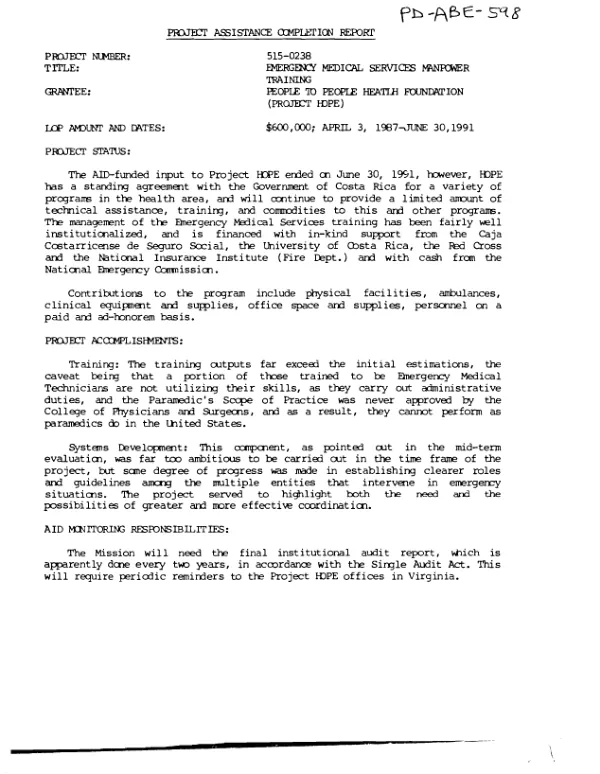
Emergency medical services : manpower training project
Summarizes final evaluation (XD-ABB-542-A) of a project to strengthen Costa Rica"s emergency medical system by providing TA and training to involved public and private sector agencies.
1990
Sign in to readA free account is required to download.

Abstract
External evaluation covered the period FY87-4/90. Unrealistic expectations, too short a time frame, and initial difficulties in recruiting appropriate technical and managerial personnel caused the project to lag behind schedule. Project HOPE, the grantee, was inexperienced in emergency medicine, lacked clear action plans and lines of authority, and was ineffective in providing administrative support to field staff. The project"s inter-institutional framework also proved unwieldy. The project failed to reach the goals of establishing an overall administrative infrastructure for emergency medical care as well as protocols for pre-hospital medical care. Additional problems include a shortage of emergency room nurses and the need for a more coordinated transportation system, including stronger controls over service costs and standards. Training targets were not met, and there is a philosophical discrepancy between the component"s academic emphasis and the practical requirements of emergency medical technical training. Trainee selection was also inappropriate in some cases. Despite these problems, the commitment of the Costa Rican medical and emergency communities, both public and private, remains impressive in terms of financial and human resources support. This commitment, combined with improved inputs being provided by Project HOPE since 1989 through a sub-agreement with the University of New Mexico, give the project reasonable prospects of achieving its prospects by PACD, extended as a result of the evaluation to 6/91. The major lesson learned is that complex systems development projects require detailed action plans with measurable goals for each component, along with specific TA needs and availability assessments. Such projects should also include all institutional actors in decisionmaking to avoid duplication of efforts and rivalries. Grantee project management must be effective from the outset.