USAID. MISSION TO COSTA RICA
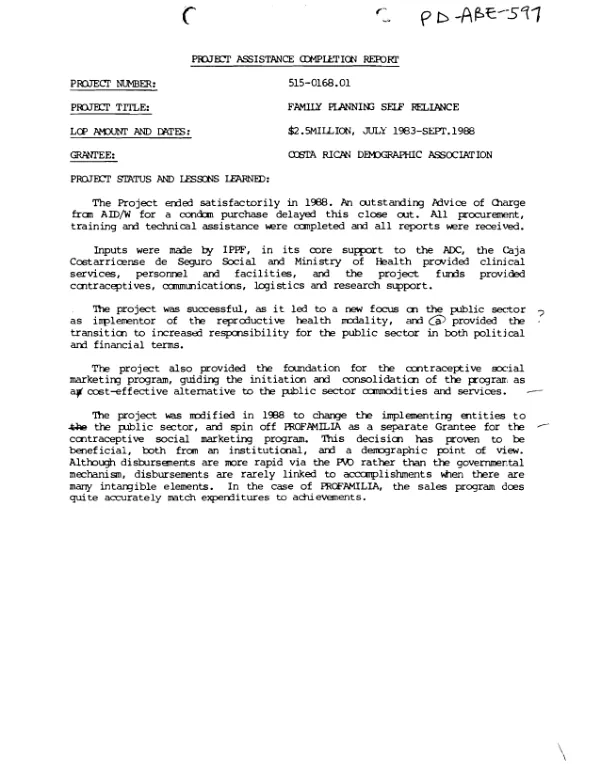
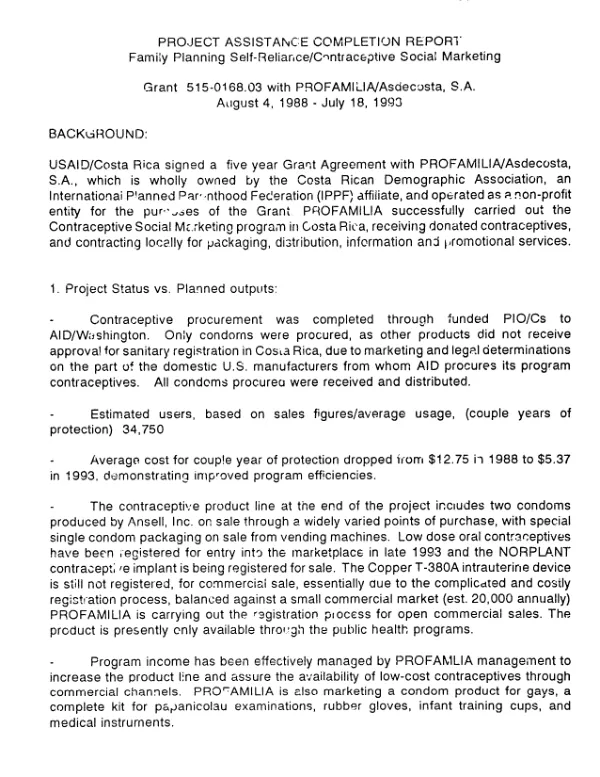
Family planning self-reliance
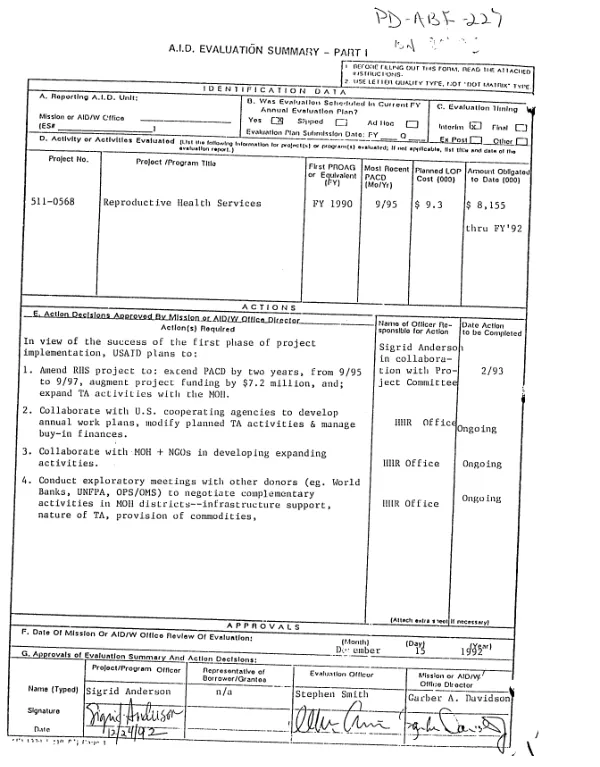
PES comments on mid-term evaluation (XD-AAV-909-A) of a project to strengthen public and private sector family planning (FP) services in Costa Rica.
Murray, Betsy; Morgan, Victor · 1987
Sign in to readA free account is required to download.
Abstract
Evaluation covered the period 8/83-8/86 and was based on document review, field visits, a beneficiary survey, and interviews with officials. The project teaches important lessons regarding the use of an intermediary organization (in this case, the Costa Rican Demographic Association - ADC) to implement FP projects. While dependence on ADC was both an appropriate strategy initially (when public sector FP proponents had to keep a low profile) and useful in easing USAID/CR"s administrative burden, it created conflict with the two government agencies involved in FP - the Ministry of Health (MOH) and the Social Security Agency (CCSS). In effect, these agencies" dependence on ADC created a false picture of roles and capabilities and politicized the FP program. CCSS and MOH now openly conduct campaigns for, e.g., reducing high risk pregnancies, birth defects, and AIDS, while ADC is criticized as an entity funded by international sources and, therefore, bad. CCSS is (very gradually) maturing as an FP institution and may be ready to take a more active role in future projects; the MOH remains resource poor and constrained. The project also underlines the importance of dynamic management for new activities such as contraceptive social marketing (CSM). USAID/CR has offered guidance to the program, but has let CSM management make operational decisions on its own. The overall quality of the attached evaluation is fair, but the scope of work was not followed and certain topics of interest were not covered. The Mission disagrees with several recommendations. (1) A training of trainers program is unnecessary (the evaluators have overlooked CCSS"s training capabilities), nor, within the integrated health/FP system, is it advisable to collect specific FP service statistics. (2) Modifying Costa Rica"s prohibition of mass media contraceptive advertising would involve changing the penal code, an area beyond USAID/CR"s normal sphere of influence; the likelihood of a successful policy dialogue on this matter is slim. (3) FP research should be conducted by academic institutions and PVO"s, not government agencies. On the other hand, the Mission agrees that reliance on ADC for contraceptive procurement should be reduced and contraceptive logistic management upgraded. Action decisions are to: conduct institutional analyses to determine the most appropriate public sector entity to manage contraceptive supplies; and consider providing increased commodity support to the public sector and increased financial support for CSM and information, education, and communication activities.