USAID. MISSION TO EL SALVADOR
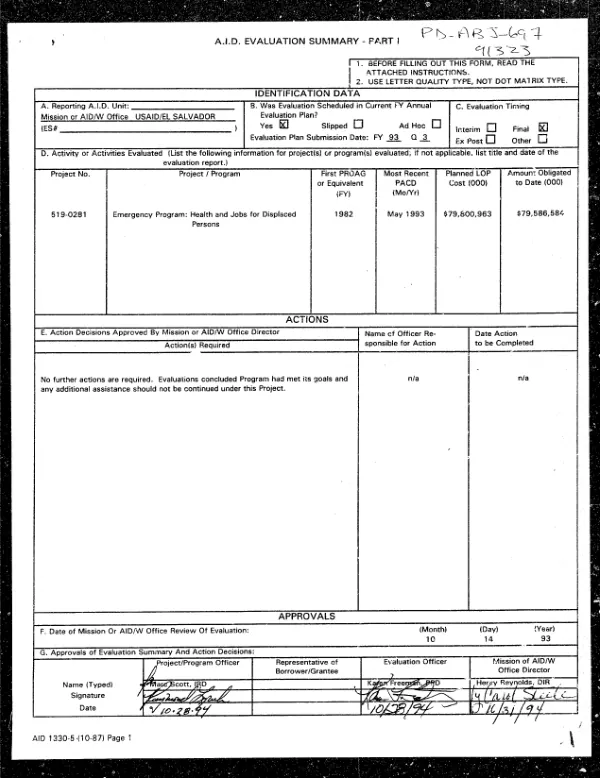
Emergency program : health and jobs for displaced persons
Summarizes final evaluation (PD-ABG-977) of a program (1982-5/93) to provide income generation opportunities, basic health services, adequate nutrition, and relocation services to people displaced by war in El Salvador.
1994
Sign in to readA free account is required to download.
Abstract
The program met its main objectives, providing a safety net for many displaced people when the government was unable to do so, and relocating in rural areas many who otherwise would have migrated to overcrowded urban centers. The jobs program provided cash employment for 150,000-200,000 people, and completed 4,968 work programs, including installation of 28,390 latrines, completion of 316 community potable water programs, and rehabilitation of 1.665 sq m of cobblestone streets. The jobs involved a broad section of the displaced population from both camps and dispersed communities. The health program provided preventive and curative care. The National Commission for Assisting the Displaced Population (CONADES) and PVOs vaccinated almost 100,000 displaced mothers and children against disease and tetanus infection, made 588,000 home visits and 83,000 clinic referrals, and trained thousands of the displaced to deal with community health problems. The food assistance program was expanded from 270,000 to over 300,000 beneficiaries after 1984, when USAID enlisted the help of CESAD, a local PVO. CESAD established 164 distribution centers which fed some 35,000 people per month. CESAD also opened 24 CENAS to feed about 5,000 children under 5 and pregnant and lactating mothers. After 1987, food for work (FFW) became the dominant approach, with CONADES distributing food to 13,000 displaced families who were resettling with the assistance of NGOs. The shift to FFW had the desired effect of removing from food assistance those who had other sources of income (such as jobs or relatives) and would not work for food. Finally, during the last 8 years of the program, CONADES and the PVOs (especially World Relief, International Rescue Committee, and Creative Associates) helped 13,218 of a targeted 16,000 families reintegrate themselves into communities. The shift to reintegration successfully graduated most people from the social welfare program. The Mission"s distribution of agricultural starter kits to resettling farmers proved particularly valuable, although the Mission might have achieved more had it worked with CONADES and the PVOs to develop a low-cost housing strategy for the displaced. Lessons learned were as follows. (1) Flexibility is crucial -- the program"s success is due to its rapid response and rolling design. (2) Responsibility should be placed on the host government as much as possible. (3) Targeting a specific group such as the displaced must be done in a way that does not alienate the poor majority; graduation from special status should occur as early as possible. (4) Coordination is often lacking and needs attention in emergency programs. (5) A jobs program is a useful tool for assisting displaced families. It helps people meet some basic needs and maintain their dignity while establishing many useful community programs. (6) Food distribution plays a key role in a displaced persons program, but needs careful management to make sure only the needy stay on the rolls. (7) Implementing institutions need strengthening, especially in civil conflicts or other emergency situations; there is a tendency to ask implementors to stretch their capacity. (8) Emergency programs should collect and use beneficiary data, disaggregated by sex. (9) Care must be taken to ensure proper financial control when large amounts of resources are involved and channelled through several organizations to a large number of beneficiaries.
Related documents
Documents in this collection
 1996
1996USAID DEC
Strategic evaluation of the US government humanitarian assistance program in northern Iraq
Open record 1990
1990USAID DEC