USAID. MISSION TO THAILAND
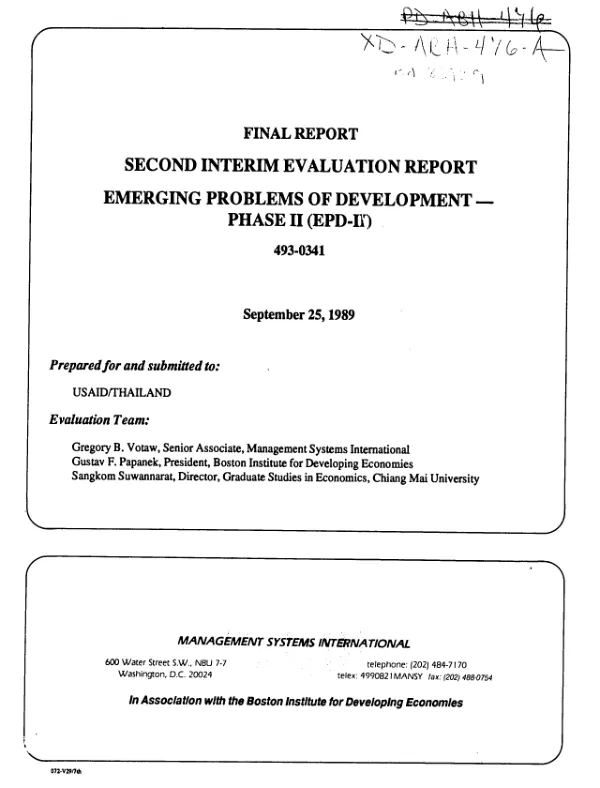
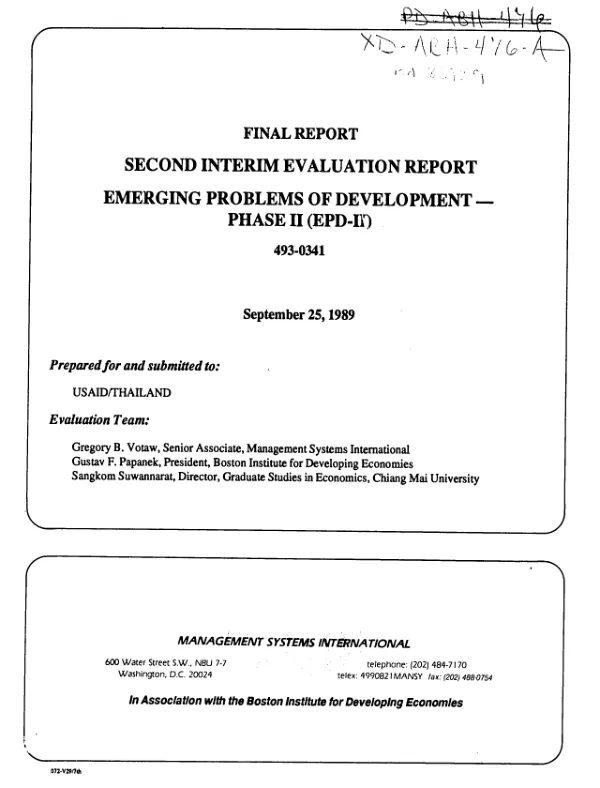
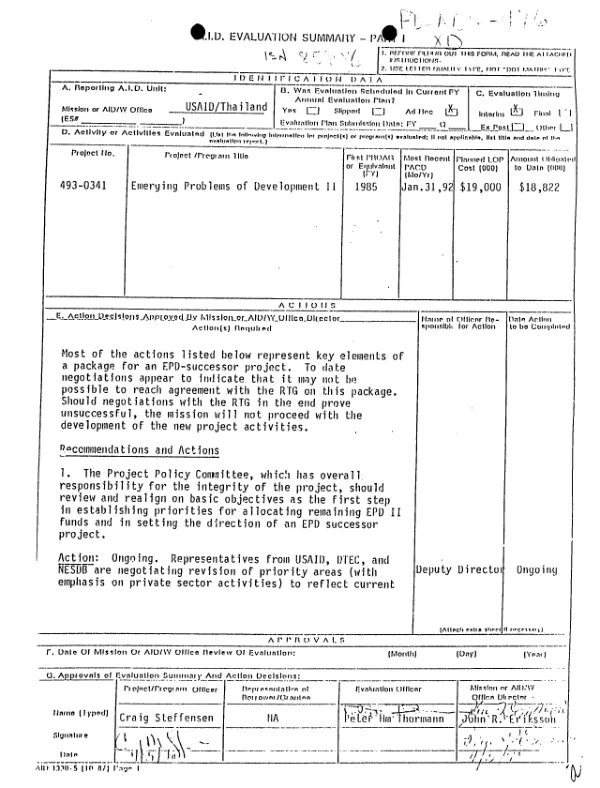
Emerging problems of development II
Summarizes attached interim evaluation (XD-ABH-476-A) of a follow-on project to strengthen the Royal Thai Government"s (RTG"s) development policy and planning capabilities.
1970
Sign in to readA free account is required to download.
Abstract
The evaluation covered the period 1985-6/89. Results have been mixed. The project has had particular success in strengthening major Thai institutions, including the Thailand Development Research Institute (TDRI), the National Social and Economic Development Board (NESDB), and the Department of Technical and Economic Cooperation (DTEC). Several of the policy studies performed by TDRI are of the highest quality. A number of other important studies will be completed soon, including pilot schemes for decentralizing environmental planning and epidemiological control to the district level, a procedure for establishing service standards for provincial city management, an analysis of long-range educational planning policies, and a telecommunications infrastructure development study. The project has supported a wide variety of seminars, workshops, short study tours, training activities, and specialized TA, such as that used by the National Energy Policy Office to develop regulations to foster private sector cogeneration projects. In most cases, these high-leverage activities have cost only a few thousand dollars. Complementary financing has been provided for several centrally funded USAID programs, including the Coastal Resources Management project of the National Environmental Board and the Natural Resources Profile, prepared under TDRI supervision. The project has also financed the completion of work begun under earlier A.I.D. projects, including a rural management training program implemented by Khon Kaen University, and has financed the activities of USAID technical officers in the areas of agricultural, health, housing, and urban development. However, the project has not had a major impact in improving resource allocation and policy formulation within Thai agencies, probably because training and study activities have been too narrowly focused. Moreover, despite TDRI"s success, it may be unreasonable to ask this institution to bear sole responsibility for formulating Thailand"s economic policy. The following other problems have been noted: (1) progress has been slow in studies of sensitive policy areas such as use of property taxes to increase municipal revenues, improving traffic flows in Bangkok, and overcoming persistent budget deficits; (2) project staff have become bogged down with details; (3) the project has failed to extend its reach beyond TDRI, NESDB, and DTEC, to other development ministries; and (4) little progress has been made toward the development of a mechanism for ongoing policy research -- the only issues explored thus far have been those named in the project design. The following lessons have been learned. (1) To review policy proposals, a technical group larger than the current 3-member committee is required. Dynamic and effective discussion of policy issues will require the addition of 3-4 senior managers from Thailand"s principal planning agency, NESDB, and 4-5 representatives of other development agencies, academia, and the private sector. (2) Given the preoccupation of senior Thai officials with many other concerns, USAID should play an active role in developing ideas for policy studies. Action decisions focus on a possible follow-on project, prospects for which are not too promising in light of recent Mission/RTG negotiations.
Related documents