USAID. BUR. FOR SCIENCE AND TECHNOLOGY. OFC. OF RURAL AND INSTITUTIONAL DEVELOPMENT
Employment and enterprise development project (EEPA)
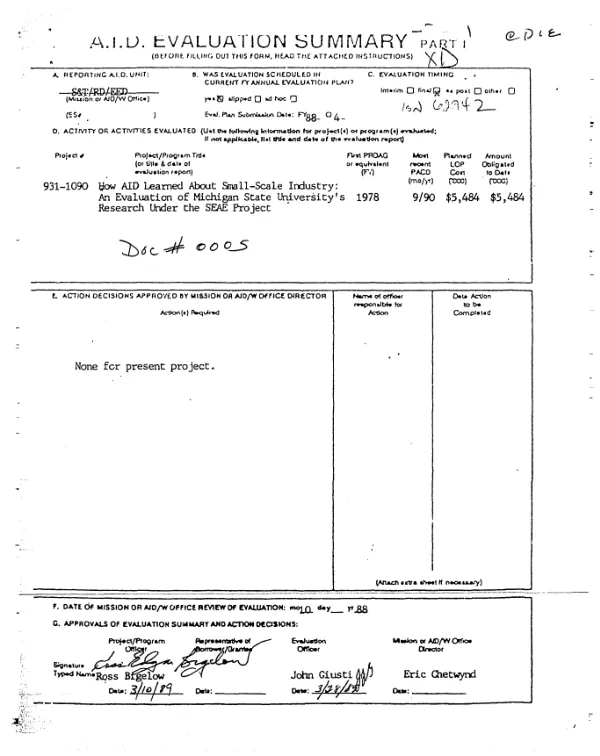
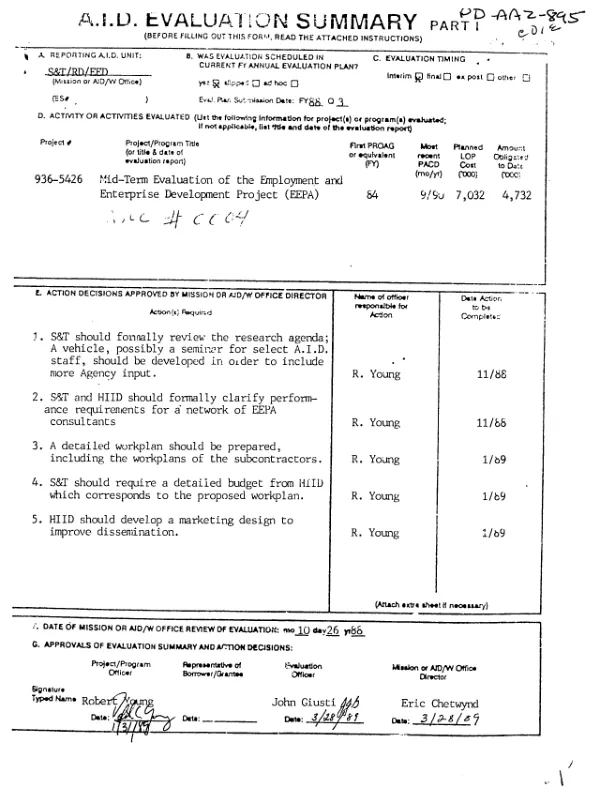
Summarizes mid-term evaluation (PD-AAX-794) of the Employment and Enterprise Policy Analysis (EEPA) Project.
1989
Sign in to readA free account is required to download.
Abstract
The project purpose is to increase both national production and the earnings of low-income groups in LDC"s and to produce more efficient and equitable patterns of resource use through small-scale enterprise development. This project was developed by S&T/RD/EED and implemented through the Harvard Institute for International Development (HIID), prime contractor, and Michigan State University and Development Alternatives Inc., subcontractors. The evaluation reviewed EEPA discussion papers and reports, interviewed A.I.D. staff both in Missions and central Bureaus and interviewed staff of the contracting organizations. The major conclusions included: State-of-the-art research has been conducted and published by the EEPA Project. The research base and methodology developed by the project could enable Missions to deal more effectively with employment generation as a policy issue. Satisfactory long- and short-term technical assistance activities have been conducted by the EEPA Project. Sustainable policy change has resulted from several EEPA technical assistance activities. Success appears to be tied to extensive involvement of Mission and Host country officials. The evaluation also noted that EEPA research has produced some important findings for policymakers. The overall findings of the research efforts have served to challenge one of the principal assumptions of the project paper, namely, that small enterprises are the best way to stimulate growth. While generally supporting the importance of small enterprises, research has shown that a broader outlook is needed and their role in each country and sector must be evaluated specifically. (Author abstract) See also abstract of PD-AAX-794.
Related documents