USAID. MISSION TO BANGLADESH
Employment and small enterprise policy project (TRP-II 0074)
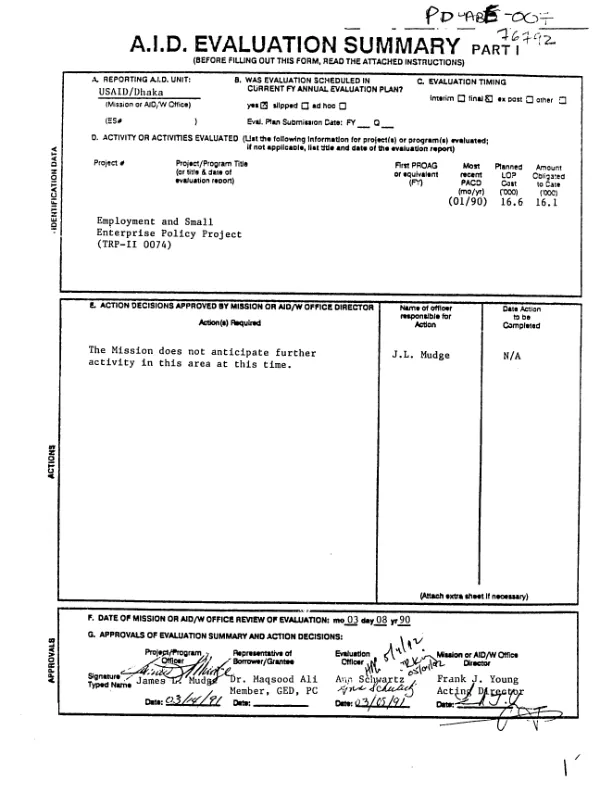
Summarizes final evaluation (XD-ABE-007-A) of a project (1987- 1990) to identify policies constricting the growth of small, labor-intensive, non-farm enterprises in Bangladesh.
1992
Sign in to readA free account is required to download.
Abstract
The project was delayed about one year. When the resident advisor arrived, his project affiliation had not yet been formalized and he had no counterparts nor office. Moreover, the primary data on which the project was to base its analysis were not available due to a series of delays in the Economic Census. It was decided that the contractor -- Harvard Institute of International Development (HIID) -- would collect its own data on small firms (relying on government data on large firms) and that the project would be extended from two years to three. Despite these start-up problems, the HIID advisor assembled a competent staff and generated an impressive volume of output. Through a steady stream of working papers, seminars, special briefings and newsletters, the HIID team has disseminated its findings to a broad audience and has become recognized in the local economics community. However, HIID focused on the CMI data, and the core issues of employment and small enterprise were comparatively neglected. Responsibility for this must be shared by HIID and USAID/B. However, while HIID has not to date identified any employment-reducing differential policy impacts on small and large firms, it may generate some evidence from analysis of its own survey data during the remaining 5 months of the project. Project research, best summarized in Working Paper 16, highlighted two findings. (1) The industrial policy reforms of 1982 and 1986 inadvertently led to greater protection of domestic industry, not less, resulting in stagnant output and declining investment. Further liberalization is required. (2) Upgrading technology is key to reinvigorating Bangladesh"s industrial performance. However, these findings, while provocative, are based on questionable data and represent preliminary hypotheses rather than substantiated conclusions. Three major lessons were learned. (1) Implementation delays should be followed by quick readjustments so that the project can address central objectives with a modified methodology if necessary. (2) When two or more project are related, they should all be managed by the same USAID office. (3) The Mission should pay special attention to projects having multiple layers of management.
![Assessment of USAID's JOBS [job opportunities and business support] program in Bangladesh within the context of the market development approach](https://covers.devme.ai/gen/5383.webp)