USAID. MISSION TO NICARAGUA
Employment generation
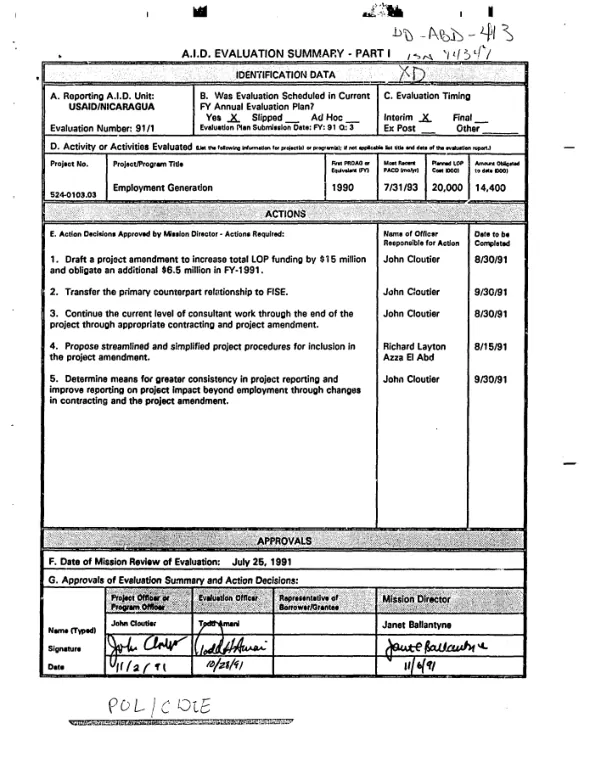
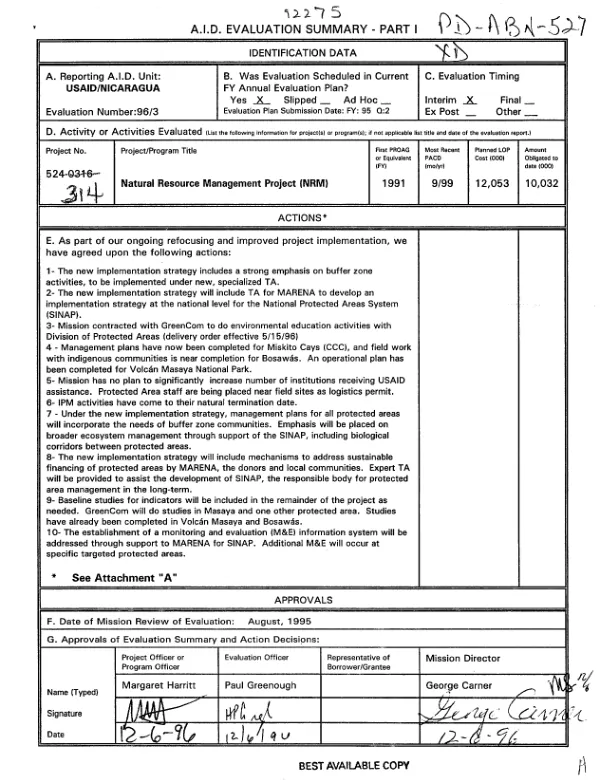
Summarizes attached interim evaluation of a project component to meet immediate employment needs in Nicaragua by hiring unemployed workers to repair basic urban infrastructure.
1991
Sign in to readA free account is required to download.
Abstract
The evaluation covered the period 9/90-7/91. The project is generally meeting the objectives for which it was designed. Implementation has moved more slowly than expected, but only because initial targets for employment generation were overly ambitious; a project design which generated significant employment more quickly would probably have meant a significant departure from the infrastructure and private sector improvement objectives of the project. Revised targets seem to be an acceptable compromise between the completing objectives of generating employment while addressing critical infrastructure needs. With project procedures and controls in place and functioning, implementation is now expected to proceed without major delays, though A.I.D. approval procedures should be simplified to reduce the administrative burden on the Mission. Additional financing of at least $5 million will be needed in FY91 in order to continue project activities at any level; other donors expected to take over financing will not be able to do so until sometime in 1992; some A.I.D. financing for FY92 should be considered as well. Primary counterpart relationship has de facto been transferred from the National Institute for Promotion of Municipalities (INIFOM) to the Social Emergency Investment Fund (FISE); a formalization of this relationship is recommended. FISE is not yet ready to assume full responsibility for the project, but should have such capacity by the end of 1991. The project should continue to finance consultants to help FISE develop this capacity; funding for vehicles and communications equipment is also recommended. Benefits related to project objectives other than employment generation, e.g., benefits to the private sector construction industry and to communities that benefit from infrastructure repair, have not been highlighted; stronger efforts to document such benefits are recommended.
Related documents