USAID. MISSION TO NICARAGUA
Natural resource management project (NRM)
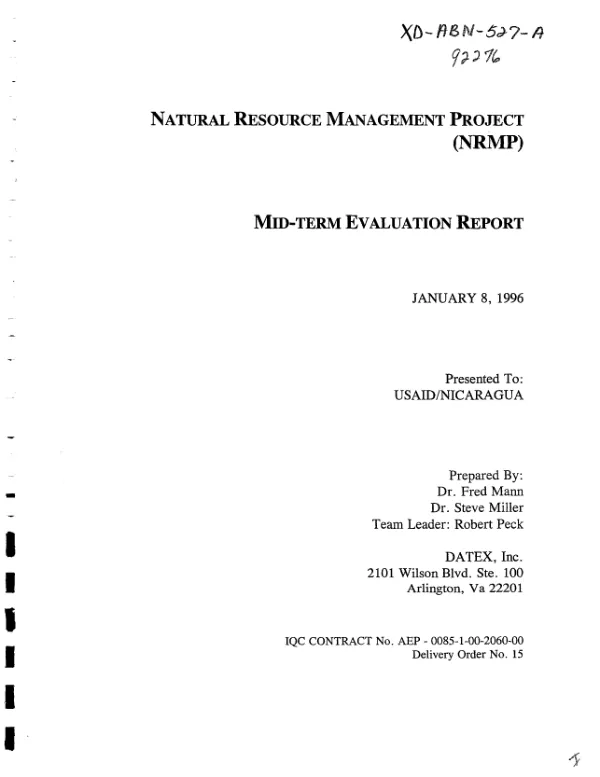
Summarizes attached interim evaluation (XD-ABN-527-A) of a project to improve renewable natural resources management (NRM) in Nicaragua.
1996
Sign in to readA free account is required to download.
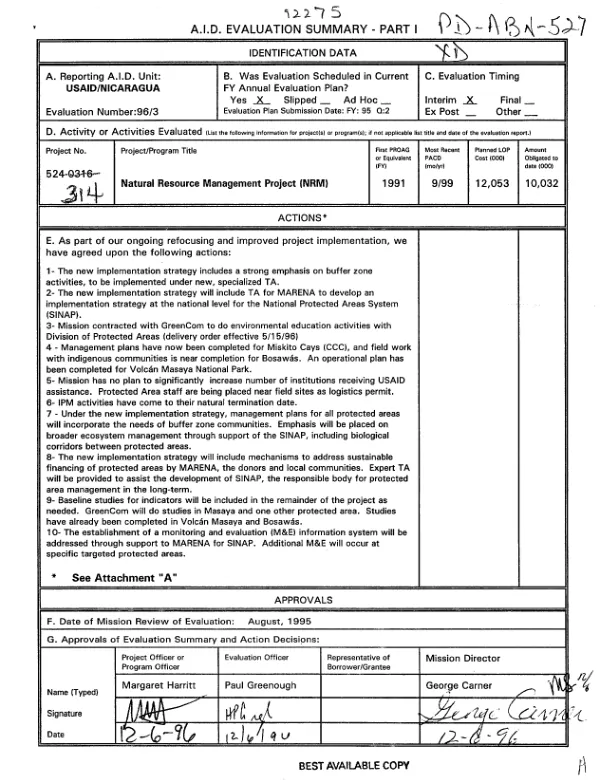
Abstract
Evaluation covered the period 9/91-1/96. The project has been progressing more slowly than expected because of a project time frame that was overly optimistic, and a project design that lacked a well-defined management plan. This has led to reactive NRM decisionmaking. Nevertheless, the rate of progress is steadily improving. Although buffer zone management was proposed by the Project Paper as an integrated part of protected area management, it has received scant attention. Three protected areas were targeted for site-specific project activities: Reserva Miskito Cays, Reserva Bosawas, and Parque Volcan Masaya. Activities at the first site were intended to be incorporated into the PVO program of the Caribbean Conservation Corporation (CCC) and in the second site into the PVO program of The Nature Conservancy (TNC). But the Cooperative Agreement with TNC does not even include buffer zone activities, and CCC has failed to develop sustainable buffer zone activities. After 2 years of seeking sustainable development partners for these activities, the project has found none. Environmental education activities have been few and their impact negligible. Future efforts should focus on the three protected areas and buffer zones being assisted, as well as on improving the technical backstopping capacity of MARENA/DGPAFF, the project"s government counterpart. Other findings are as follows. (1) During project start-up, the heavy burdens placed on NGO Chiefs of Party often delayed initiation of key field activities. Management plans to focus project activities and set priorities have not been drafted for either Bosawas or for Miskito Cays after 2 years of activity. (2) Due to the lack of onsite, senior, technically qualified, supervisory and management expertise, quality of content in institutional strengthening and policy improvement activities is not being monitored. (3) USAID/N proposes to increase the number of major USAID-funded implementing institutions from 3 to 7 or 8. This will exacerbate what already is an extremely difficult and complex management and coordination responsibility for USAID/N. (4) While most of the micro-objectives of the integrated pest management (IPM) component have been achieved in terms of training and technology transfer, little progress has been made toward sustainability, as activities are still dependent on external funding. (5) Buffer zone activities in interacting ecological zones adjacent to the reserves are not being considered. (6) The financial sustainability of the project"s environmental protection (EP) activities is remote. MARENA must show the capacity to serve national interest to gain support from client groups. The entire system by which resources for EP, especially for protected areas management, are attracted, accepted, and allocated, must be considered. (7) The social settings of both Miskito Cays and Bosawas were disrupted by forced resettlement during the war. A good understanding of the social dynamics of the populations of these areas and their buffer zones is necessary to ensure just treatment of all resident populations, and to formulate strategies and programs to make them active partners in co-management. A sound design for improving protected areas management is not feasible for biodiversity protection without a baseline analysis. (8) Little progress has been made in establishing automated data and information systems for operational and technical management purposes. This is required urgently as a tool for effective operation and management of the new MARENA. The Mission agrees with the evaluators that buffer zone activities need to be emphasized during the remainder of the project, but insists on the Reserva Bosawas as the sole target area; the Mission ended its contract with CCC in the Miskito Cays area because of a decreasing staff and budget resources for NRM, a shift in the Mission"s overall NRM strategy, and because the USAID regional environmental project, PROARCA, began work in the reserve this year though a local indigenous NGO.
![End of program evaluation report (Nov 1999-Oct 2002) : cooperative agreement between USAID and WWF [World Wildlife Fund] Indonesia no. 497-A-00-00-00002-00 -- the Outer Islands bioregional program : integrated protected area management and spatial planning in Kalimantan and Papua[, Indonesia]](https://covers.devme.ai/gen/5324.webp)