USAID DEC
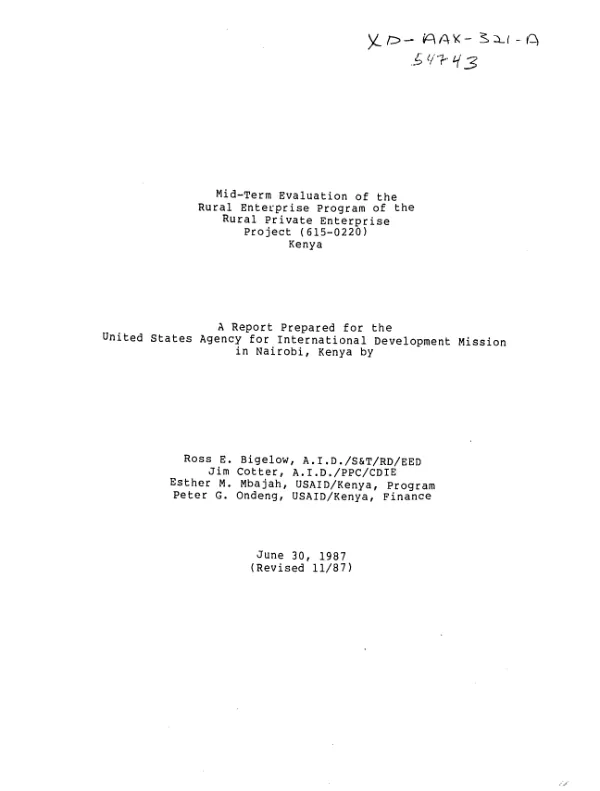
End of project evaluation of the small business scheme of the National Christian Council of Kenya
Sign inUSAID. BUR. FOR AFRICA. OFC. OF REGIONAL AFFAIRS
End of project evaluation of the small business scheme of the National Christian Council of Kenya
Evaluates OPG to the National Christian Council of Kenya (NCCK) to provide credit and TA to entrepreneurs, mainly in 5 secondary cities: Mombasa, Nakuru, Eldoret, Kakamega, and Kisumu.
Hunt, Robert W.; Mirero, S. M. A. · 1985
Sign in to readA free account is required to download.
Abstract
External final evaluation covers the period 1980-6/84 and is based on site visits, document review, and interviews with A.I.D., NCCK, TA, and other knowledgeable personnel and with beneficiaries. NCCK has developed an impressive capability for providing TA and credit, despite a climate of economic distress and refugee pressure in Kenya. Loans have been provided to 315 individual firms (most are fruit and vegetable vendors, traders in charcoal or clothing, or tailors), but to only 15 groups; the former figure is far over target, the latter far beneath. TA (mainly in credit, procurement, stock control, and bookkeeping) has been provided to some 6,000 individuals. Most of this assistance has gone as planned to the very poor. There is, however, doubt as to whether beneficiary gains - in income, quality of life, and skills - are being sustained. Based on the experience it has gained, NCCK should be able to expand its activities in the future while lowering costs and better assuring that the assistance has the desired social impact. However, NCCK will have to increase stability among top level project management, lack of which in the past has threatened to undermine project coherence and direction. Other areas in which NCCK is weak include client selection and follow-up/loan repayment activities. The project teaches many lessons, among them: (1) teams of social workers and business promoters, despite their differences in training and background, can effectively deliver TA and credit to microentrepreneurs; (2) new skills tend to be used less with passage of time, and family and business income to decline; (3) securing regular repayment from informal sector entrepreneurs poses difficult problems; (4) very poor clients need buffers against short-term emergencies that could undermine their businesses; (5) while decentralization of responsibility to social worker/promoter teams seems to produce initiative and commitment, central administration support and adequate information on program goals are still needed; (6) both regional and national staff require regular training on the development significance of what they are doing; (7) institution building at NCCK was facilitated by top-level commitment and by valuable TA from Development-GAP (a PVO); and (8) group formation and development are more complex and costly than expected. Several recommendations are made.