USAID. MISSION TO ECUADOR
Project assistance completion report : small enterprise development
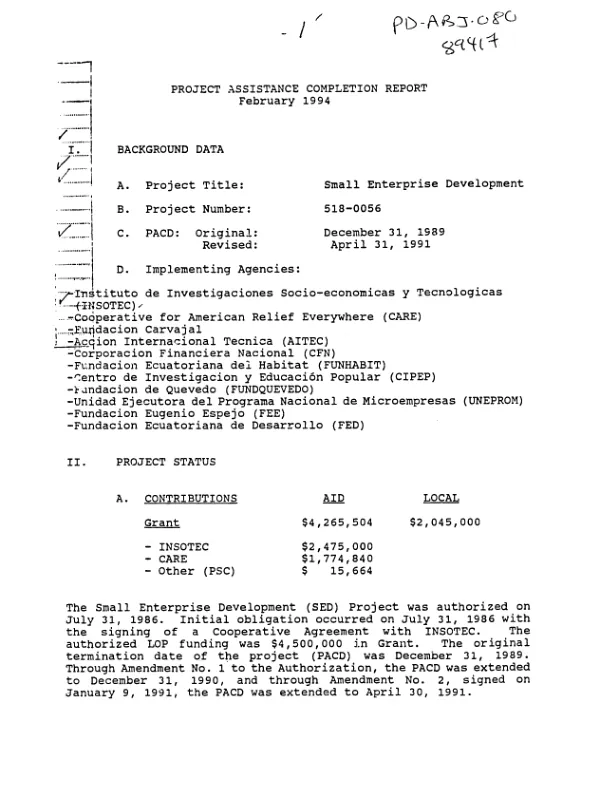
PACR of a project (7/86-4/91) to expand the supply of TA, credit, and training to the small-scale enterprise (SSE) sector in Ecuador.
1994
Sign in to readA free account is required to download.
Abstract
The project, which was implemented in five secondary cities on the coast (planned efforts in the sierra were dropped), included two components: (1) Instituto de Investigaciones Socio-economicas y Tecnologicas (INSOTEC) provided TA to enterprises that made intensive use of local labor and materials, especially in the food processing, clothing, wood product, and metal works sectors; (2) CARE, working through Fundacion Carvajal and Accion International (AITEC) and their subgrantees, provided training and credit. Thousands of microentrepreneurs, many of them women, were trained in business administration by local foundations using the methodology developed by Fundacion Carvajal in Colombia, and more than 4,000 loans were made. By the PACD, the project had helped to create 2,149 new jobs, and the 5% increase in value added during 1988 and 1989 in projected-assisted microenterprises surpassed expectations. Several lessons were learned. (1) The project"s design was too complex and far-reaching. The participation of many institutions and the abundance of services offered led to overlapping of functions and lack of coordination. (2) The creation of new foundations in the secondary cities to carry out the project was not at all successful; the foundations were organizationally weak and their leaders not genuinely committed to microenterprise strengthening, as was evident when they abandoned their programs after the project ended. The use of existing institutions such as INSOTEC proved much more effective in developing and replicating programs. (3) Support for small enterprises should be integrated, i.e., should include credit, TA, and management training. (4) Channelling credit through the formal banking system was not effective. Because of the program"s social nature, the banks gave it only limited support, and the program served the banks more than it did the SSE sector. Also, the credit provided was insufficient to allow participating NGOs to cover their operating expenses. Channelling credit through the foundations would have been a better option. (5) Continuation of project activities after the PACD has been only partial. Of the new NGOs, only the INSOTEC office in Santo Domingo is still operating; of existing NGOs strengthened by the project, those in Guayaquil, Quito, Esmeraldas, and Cuenca continue to operate their own programs. The expectations raised by the government"s new microenterprise program, CONAUPE, have apparently discouraged private institutions from continuing to work in the SSE sector. (6) Support for NGOs through the use of subgrants was not effective. Direct agreements between the NGOs and USAID may be a better alternative. (7) Credit graduation was achieved in very few cases: microentrepreneurs are reluctant to request loans from banks because of paperwork and collateral requirements. Institutional graduation (i.e., to cooperatives and associations) is a more feasible target. Future programs need to take into account the political and economic environment of each community. (8) A final project evaluation should have been conducted (instead of a sector assessment, as was the case).