USAID
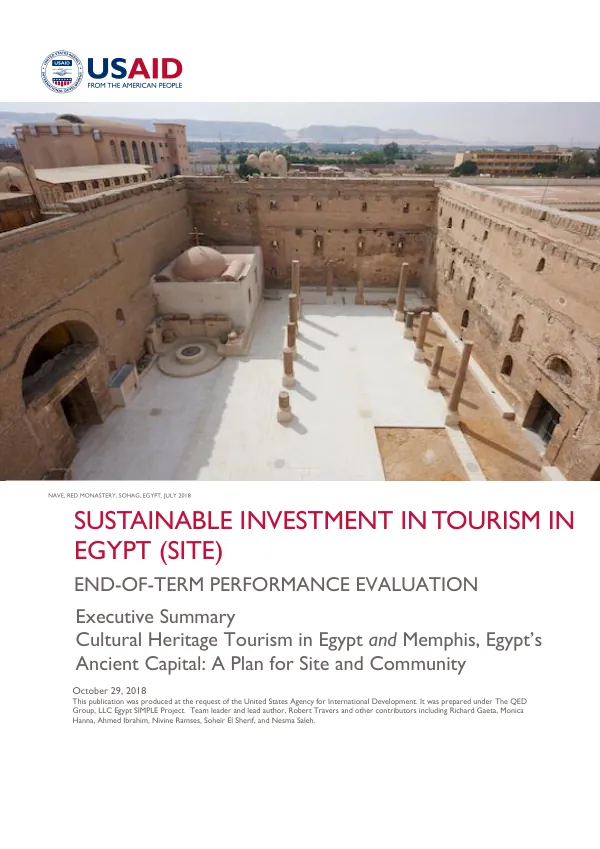
Red Monastery Nave Conservation and Training Project
The Red Monastery Nave Conservation and Training Project is a cultural heritage tourism project funded by the USAID Agreement No.
2016 · 21 pages
Sign in to readA free account is required to download.
Abstract
263-A-15-00007. The project was awarded to the American Research Center in Egypt (ARCE) and was implemented in collaboration with the United States Agency for International Development and the Egyptian Ministry of State for Antiquities. The project's primary objective was to conserve a section of the west wall of the nave at Deir el-Ahmar, a medieval monastery in Egypt. The conservation campaign took place between March 30 and April 20, 2016, and was led by Dr. Alberto Sucato, chief conservator, and Dr. Emiliano Ricchi. The team consisted of conservators from ARCE and the Egyptian Ministry of Antiquities, as well as student conservators. The west wall of the nave was in a severely damaged state, with extensive falls of plaster revealing the underlying brick masonry. The plaster had been exposed to the elements for centuries, resulting in widespread surface encrustations, deposits, and damage caused by natural agents such as dust, sand, and sooty deposits. The presence of large numbers of birds also inflicted constant wear on the plaster, causing small holes and widespread abrasion. The team refined the working methods to be used in the on-the-job training for student conservators and erected and tested an optimal layout for the scaffolding to ensure safe working conditions. The masonry of the nave is composed of fired brick, partly medieval and partly late antique, with a bedding mortar made of lime, sand, and fragments of local brick and brick dust. The plaster used in the nave is made of lime and sand with a generous amount of straw in the mix, resulting in a pale yellow color and a fine-grained texture. The plaster was applied in layers ranging from 5 to 10 mm in thickness and was finished with a thin layer of whitewash, probably lime wash. The team discovered a small graffito of a quadruped and a second shape that proved impossible to identify, both of which were probably incised during the medieval period. The conservation campaign provided valuable data and results, allowing the team to formulate a feasible schedule for the entire project and to understand the most suitable methods for tackling and repairing areas where extensive falls of plaster have revealed the underlying brick masonry. The test cleanings carried out on the right side of the north wall helped to ascertain whether there are wall paintings in the area, providing vital data for deciding whether to extend the gallery floor to be rebuilt.