FAMILY HEALTH INTERNATIONAL
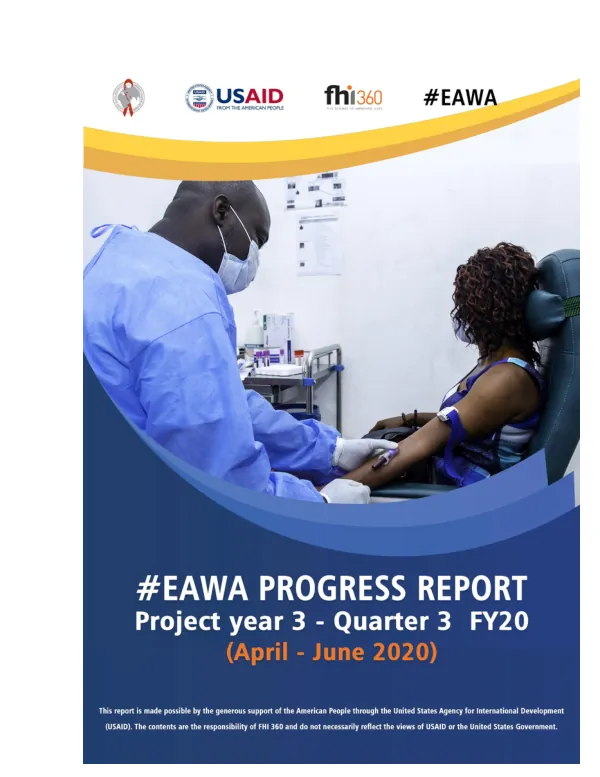
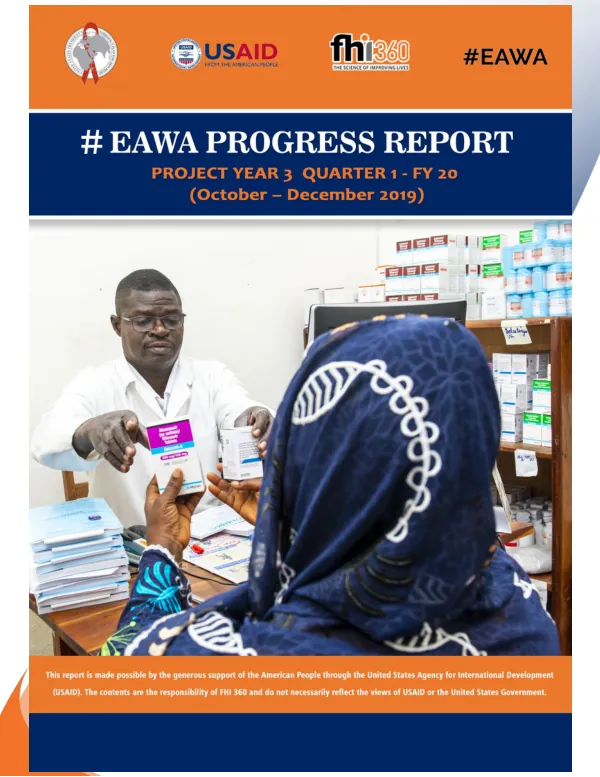
Ending AIDS in West Africa Project (#EAWA) Quarterly Report Q1 FY20
The Ending AIDS in West Africa Project (#EAWA) is a five-year cooperative agreement between the United States Agency for International Development West Africa Mission (USAID/WA) and Family Health International (FHI 360).
2020 · 35 pages
Sign in to readA free account is required to download.
Abstract
The project aims to accelerate progress across the region towards Ending AIDS in West Africa through prevention, care and treatment, focusing on Key Populations to accelerate the achievement of UNAIDS 90-90-90 targets. The project oversees three components of the Game Changer: the service delivery component, the laboratory system strengthening component, and the monitoring and evaluation component. The service delivery component of the Game Changer aims to reach nationally the first and second 90 in FY20 in Burkina Faso and Togo, and achieve the third 90 in FY21 through direct service delivery, with a targeted focus on the highest burden sites for PLHIV and KP. During the first quarter of year 3, a total of 2,660 unique key populations (MSM and FSW) were reached with prevention interventions in both Togo (1,427) and in Burkina Faso (1,233). A total of 22,053 individuals (including 1,955 KPs) were tested for HIV and received their test results. Among those who did HIV test, 4,272 individuals (including 240 KPs) were newly diagnosed HIV positive (19.4% case finding). About 100% (n= 4,270) of the individuals diagnosed HIV positive have been successfully enrolled on ART during the reporting period. The linkage to ART rate was higher among female (102.6%) than among male (94.4%). The project recorded a TX_CURR 44,287 ART patients receiving treatment, including 25,037 ART patients in Togo and 19,250 ART patients in Burkina Faso. The viral load data was extracted from the national electronic laboratory information system. At the end of December 2019, viral load results were documented for 7,984 ART patients (5,888 patients in Togo and 2,096 patients in Burkina Faso). The percentage of ART patients with a suppressed viral load (VL) result (<1000 copies/ml) at the end of this quarter is 82.4% in Togo and 85.4% in Burkina Faso. The project has reached only the set target for KP_PREV in Burkina Faso, with some delays due to the finalization of workplans, elaboration of scope of works, budgets and other documents for subawards with the 37 DSD project sites and other partners, the sites preparedness, the recruitment of sites staff and the training of the new staff recruited by sites. These activities impacted negatively on the achievement of the project's core indicators. The project has made significant progress in reaching key populations with prevention interventions, testing, and ART initiation. The linkage to ART rate was higher among female than among male. The project has also made progress in viral load suppression, with a percentage of 82.4% in Togo and 85.4% in Burkina Faso. However, the project has faced some challenges in achieving its core indicators due to delays in the implementation of the Game Changer Fund. The project will continue to work towards achieving its goals and objectives, with a focus on Key Populations and PLHIV. The project will also continue to strengthen its laboratory system and monitoring and evaluation components to ensure that it is able to track its progress and make adjustments as needed. The project will also continue to work with its partners to ensure that the project is implemented effectively and efficiently. The project has made significant progress in reaching key populations with prevention interventions, testing, and ART initiation. The linkage to ART rate was higher among female than among male. The project has also made progress in viral load suppression, with a percentage of 82.4% in Togo and 85.4% in Burkina Faso. The project will continue to work towards achieving its goals and objectives, with a focus on Key Populations and PLHIV. The project's success will depend on its ability to continue to reach key populations with prevention interventions, testing, and ART initiation. The project will also need to continue to strengthen its laboratory system and monitoring and evaluation components to ensure that it is able to track its progress and make adjustments as needed. The project will also need to continue to work with its partners to ensure that the project is implemented effectively and efficiently. The project's progress will be closely monitored and evaluated to ensure that it is on track to achieve its goals and objectives. The project will also continue to make adjustments as needed to ensure that it is able to achieve its goals and objectives. The project's success will depend on its ability to continue to reach key populations with prevention interventions, testing, and ART initiation, and to strengthen its laboratory system and monitoring and evaluation components.