USAID DEC
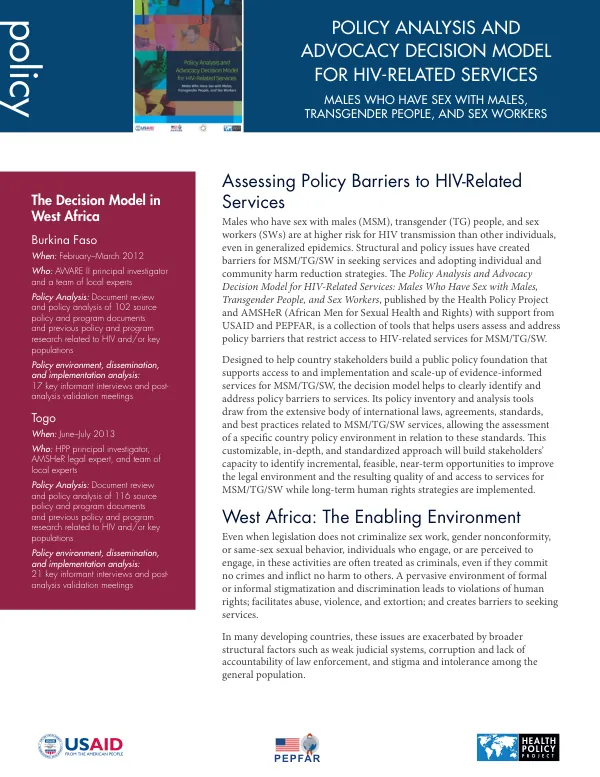
Policy Analysis and Advocacy Decision Model for HIV-Related Services: Males Who Have Sex with Males, Transgender People, and Sex Workers
Sign inAVENIR HEALTH
Policy Analysis and Advocacy Decision Model for HIV-Related Services: Males Who Have Sex with Males, Transgender People, and Sex Workers
Males who have sex with males (MSM), transgender (TG) people, and sex workers (SWs) are at higher risk for HIV transmission than other individuals, even in generalized epidemics.
2015 · 2 pages
Sign in to readA free account is required to download.
Abstract
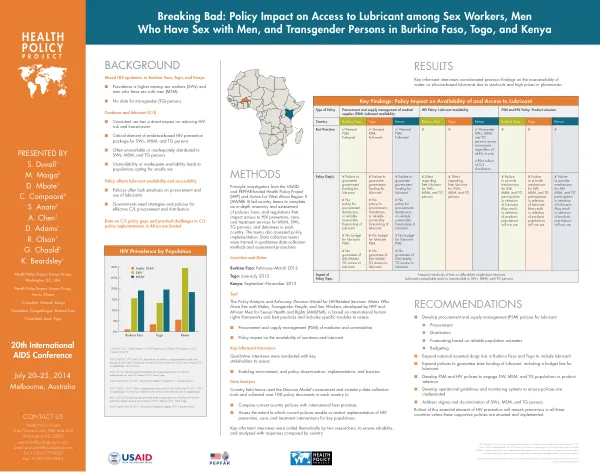
Structural and policy issues have created barriers for MSM/TG/SW in seeking services and adopting individual and community harm reduction strategies. The Policy Analysis and Advocacy Decision Model for HIV-Related Services: Males Who Have Sex with Males, Transgender People, and Sex Workers is a collection of tools that helps users assess and address policy barriers that restrict access to HIV-related services for MSM/TG/SW. The decision model is designed to help country stakeholders build a public policy foundation that supports access to and implementation and scale-up of evidence-informed services for MSM/TG/SW. Its policy inventory and analysis tools draw from the extensive body of international laws, agreements, standards, and best practices related to MSM/TG/SW services, allowing the assessment of a specific country policy environment in relation to these standards. This customizable, in-depth, and standardized approach will build stakeholders' capacity to identify incremental, feasible, near-term opportunities to improve the legal environment and the resulting quality of and access to services for MSM/TG/SW while long-term human rights strategies are implemented. In West Africa, even when legislation does not criminalize sex work, gender nonconformity, or same-sex sexual behavior, individuals who engage, or are perceived to engage, in these activities are often treated as criminals, even if they commit no crimes and inflict no harm to others. A pervasive environment of formal or informal stigmatization and discrimination leads to violations of human rights; facilitates abuse, violence, and extortion; and creates barriers to seeking services. In many developing countries, these issues are exacerbated by broader structural factors such as weak judicial systems, corruption and lack of accountability of law enforcement, and stigma and intolerance among the general population. The Health Policy Project, in collaboration with AMSHeR and supported by USAID and PEPFAR, has implemented the Policy Analysis and Advocacy Decision Model in several countries, including Burkina Faso and Togo. In Burkina Faso, the decision model was implemented in 2012, and in Togo, it was implemented in 2013. The implementation involved document review and policy analysis of source policy and program documents, as well as key informant interviews and post-analysis validation meetings. The decision model helped to identify policy barriers and gaps in Burkina Faso and Togo, including the need for data collection and disaggregated reporting for MSM and SWs, policies to offer free STI kits for SWs, and policies to require engagement of MSM/SW and/or NGOs in HIV, STI, or SRH policy/program development, implementation, or monitoring. The decision model also identified policy gaps in Burkina Faso and Togo, including the criminalization of same-sex sexual acts, sex work, and/or soliciting, and the lack of policies to address the needs of MSM/SW, including stigma and discrimination. The model provided recommendations for addressing these policy gaps and improving the legal environment and the resulting quality of and access to services for MSM/TG/SW.
Related documents