SOCIAL IMPACT, INC.
Endline Implementation Brief - St. Lucia: Juvenile Justice Reform
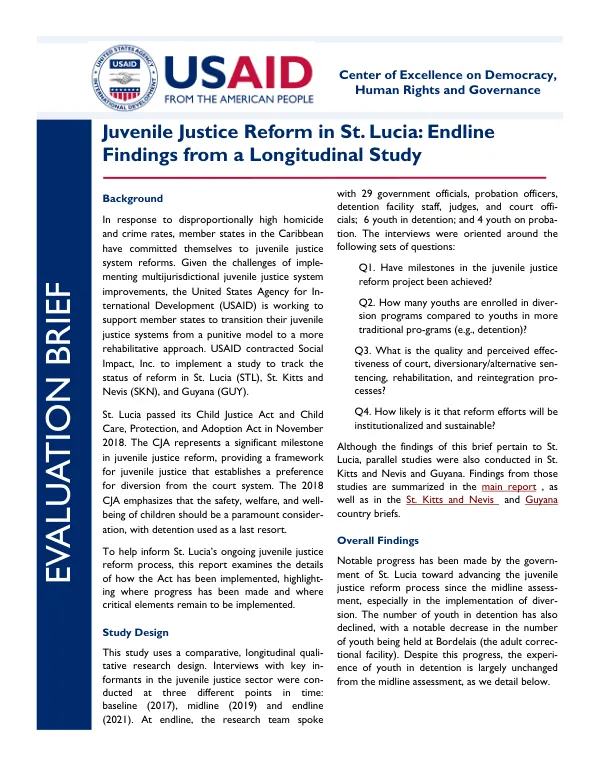
The juvenile justice reform process in St.
2021 · 3 pages
Sign in to readA free account is required to download.
Abstract
Lucia has made notable progress since the midline assessment, particularly in the implementation of diversion. The number of youth in detention has decreased, with a notable decline in the number of youth being held at Bordelais Correctional Facility. The Child Justice Act, passed in November 2018, provides a framework for juvenile justice that establishes a preference for diversion from the court system. Implementation of the CJA has been facilitated by the establishment of a Technical Committee to oversee the reform process. However, coordination challenges persist, and the Child Justice Management Unit, recommended to oversee the reform process after the close of the JJRP, has been delayed due to resource constraints. The Royal St. Lucia Police Force has continued to employ community policing practices beneficial to juvenile justice objectives, but the police have yet to be fully integrated into and sensitized on the juvenile justice reform process. Diversion and alternative sentencing have been integrated into the juvenile justice system, with notable progress in pre-trial and post-trial diversion mechanisms. The Department of Probation and Parole appears to be leading pre-trial diversion processes and coordinating Initial Inquiry meetings. Post-trial diversion via the Family Court has also been operationalized, with the majority of diversion orders made by the court being for Supervision and Guidance. However, there is a critical need for a set of official diversion programs to be formalized so that the Court and probation officers have more structured options to divert youth to. Probation officers continue to use assessment tools, including the Structured Assessment of Violence Risk in Youth. The Department continues to have one officer dedicated to supervising juveniles, and at endline had three additional officers supporting on juvenile matters. The number of juveniles in detention has substantially decreased from 38 at midline to 13 at endline. Detained youth are still being held in two detention facilities, Bordelais Correctional Facility and the Boys Training Center. Despite the CJA's assertion that 16-18-year-olds are still classified as children, juveniles charged with serious offenses are still often detained at Bordelais. At BTC, there is still no on-site medical or mental health services, and the Center is reliant on local hospitals and clinics to provide these services. Bordelais has an on-site medical unit, but only one clinical social worker to provide mental health support to approximately 500 incarcerated people and no on-site psychiatrist. BTC continues to offer a selection of vocational training opportunities, but there still appears to be little to no oversight by the Ministry of Education of the academic education being provided. The majority of youth respondents did not report any acts of physical abuse, neither at BTC nor Bordelais. Forms of punishment reported at BTC consist of labor and being subjected to time in the facility's solitary confinement space. The COVID-19 pandemic significantly impacted operations at both facilities, halting or reducing the scope of programming and in-person visitation. Reintegration was consistently mentioned as one of the highest priority areas for juvenile justice reforms in St. Lucia. Experiences reported by youth at both facilities varied widely, with some youth reporting having no conversations at all with family, counselors, or probation officers related to rehabilitation and re-entry, while others had already secured a job ahead of leaving detention. BTC still operates a two-year aftercare program, though it seems to be significantly underfunded and under-resourced. As was the case at baseline and midline, Bordelais still has little in place with regards to re-entry programming. Based on these high-level findings, five topline recommendations are offered: the government should continue training and sensitization activities, including trainings on the proper process and procedures for handling cases involving juveniles. The government needs to ensure that BTC and Probation have the resources they need to adequately fulfill their responsibilities within the juvenile justice system. The government should prioritize the development of reintegration programs, including aftercare programs, to support youth upon release from detention. The Ministry of Education should take a more active role in overseeing the academic education provided at BTC. Finally, the government should prioritize the development of diversion programs to provide more structured options for diverting youth from the court system.