USAID DEC
USAID Eastern and Southern Caribbean Regional Climate Symposium Session VIII Summary
Sign inENVIRONMENTAL INCENTIVES, LLC
USAID Eastern and Southern Caribbean Regional Climate Symposium Session VIII Summary
The USAID Eastern and Southern Caribbean Regional Climate Symposium took place from June 16 to June 30, 2021.
2021 · 3 pages
Sign in to readA free account is required to download.
Abstract
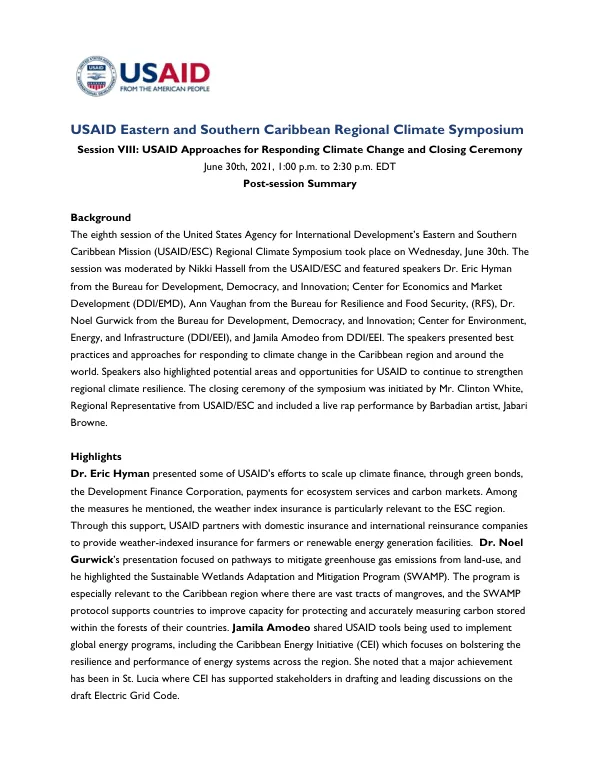
The symposium was hosted by the United States Agency for International Development's Eastern and Southern Caribbean Mission (USAID/ESC) and featured eight sessions. High-level speakers from USAID/ESC and its partners discussed the ecological and human dimensions of climate change, contextualized the Eastern and Southern Caribbean region's response, and sought solutions to address impacts. The eighth session, moderated by Nikki Hassell from USAID/ESC, featured speakers Dr. Eric Hyman from the Bureau for Development, Democracy, and Innovation; Center for Economics and Market Development (DDI/EMD), Ann Vaughan from the Bureau for Resilience and Food Security (RFS), Dr. Noel Gurwick from the Bureau for Development, Democracy, and Innovation; Center for Environment, Energy, and Infrastructure (DDI/EEI), and Jamila Amodeo from DDI/EEI. The speakers presented best practices and approaches for responding to climate change in the Caribbean region and around the world. Dr. Eric Hyman presented USAID's efforts to scale up climate finance through green bonds, the Development Finance Corporation, payments for ecosystem services, and carbon markets. He highlighted the weather index insurance as a particularly relevant measure for the ESC region. This support involves partnering with domestic insurance and international reinsurance companies to provide weather-indexed insurance for farmers or renewable energy generation facilities. Dr. Noel Gurwick's presentation focused on pathways to mitigate greenhouse gas emissions from land-use. He highlighted the Sustainable Wetlands Adaptation and Mitigation Program (SWAMP), which is especially relevant to the Caribbean region where there are vast tracts of mangroves. The SWAMP protocol supports countries to improve capacity for protecting and accurately measuring carbon stored within the forests of their countries. Jamila Amodeo shared USAID tools being used to implement global energy programs, including the Caribbean Energy Initiative (CEI). The CEI focuses on bolstering the resilience and performance of energy systems across the region. She noted that a major achievement has been in St. Lucia, where CEI has supported stakeholders in drafting and leading discussions on the draft Electric Grid Code. Ann Vaughan presented on the work of the Resilience Food and Security Bureau and recent USAID deliverables coming from the Leaders' Summit on Climate Change. Of relevance to the Caribbean region are the climate finance commitments, which include an investment of $250 million to attract $3.5 billion in private sector financing by 2025 and supporting 20 climate vulnerable countries to double private sector funds for adaptation and resilience goals by 2025. The closing ceremony was initiated with a short video highlighting the USAID-supported Water Resources Management and Flood Resilience project in Barbados, which resulted in the significant reduction of flooding in a community on the West Coast. Mr. Clinton White, Regional Representative from USAID/ESC, recapped the eight sessions over the previous three weeks and shared key takeaways. He remarked that "The information presented will benefit all of us, citizens, governments, the private sector, donors across the Caribbean as we grapple with finding ways to address the impact of climate change." Key takeaways from the symposium include the importance of private sector financing, the potential of ecosystems to increase resilience against climate impacts, and USAID's commitment to developing a new ambitious climate change strategy that will ramp up mitigation and adaptation efforts and increase climate change mainstreaming in development and humanitarian programming.