USAID. BUR. FOR POLICY AND PROGRAM COORDINATION. CENTER FOR DEVELOPMENT INFORMATION AND EVALUATION (CDIE)
Energy conservation in the Philippines
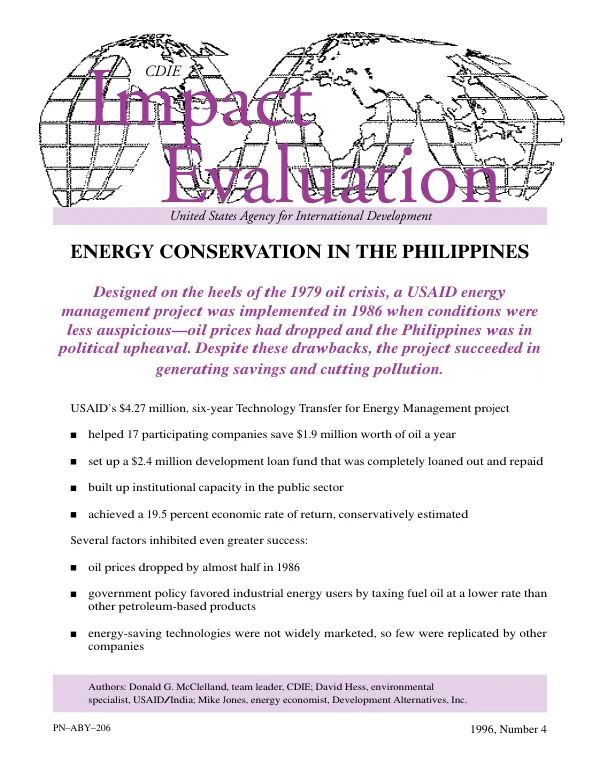
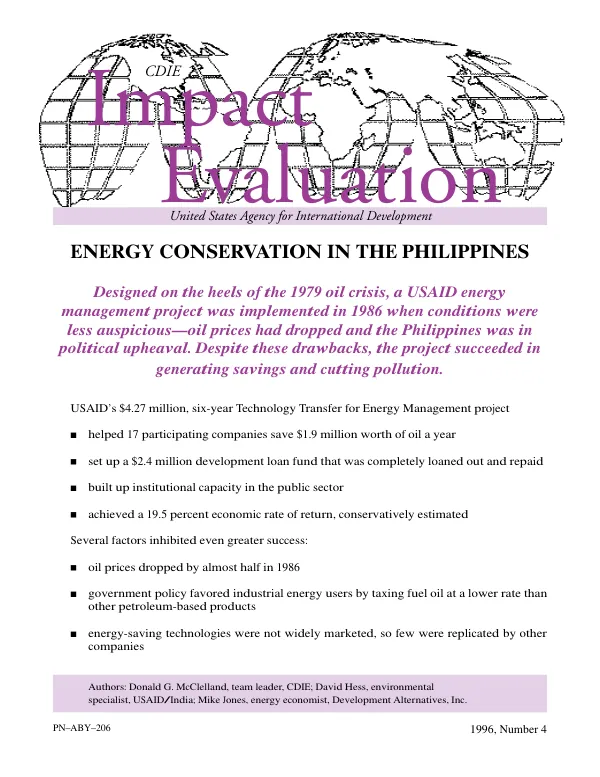
USAID's Technology Transfer for Energy Management Project in the Philippines (1986-92), designed to promote the adoption of energy-efficient technologies in the industrial and commercial sectors in the wake of the 1979 oil crisis, was successful in a number of ways.
McClelland, Donald G.|Hess, David|Jones, Mike · 1995
Sign in to readA free account is required to download.
Abstract
By project end, 30 technology demonstrations had taken place at the 17 participating companies, and financial payback periods ranged from 0.3 to 20.9 years, averaging 1.8 years. All $2.4 million set aside in the development loan fund had been loaned and all loans repaid. Taken together, the 17 companies saved 109,331 barrels of oil, valued at $1.9 million, per year. The estimated financial rate of return was greater than 12% for 11 of the firms, and greater than 28% for 8 of them. Nonetheless, more energy could have been saved. There are several reasons for this. When the project was implemented, host government policy favored industrial energy users by taxing fuel oil less than other petroleum-based products. The financial incentive for these companies to conserve energy was less than for other companies, and this was reduced further when the price of a barrel of oil dropped from $28 in 1984 to $13 and 1986. For the most part, the energy-saving technologies demonstrated under the project were technically and financially sound, though in some cases they had little replication potential or would probably have been adopted by the companies without project financing. In addition, because the project did not market the technologies widely, there was little direct replication beyond the 17 companies. Additionally, institution-building was unsuccessful in the private sector, where it was a high project priority, but successful in the public sector, where it was not a high project priority. The study suggests six lessons learned. (1) Government and donor commitment to energy conservation is fundamental to project success. (2) Private firms need substantial financial incentives to invest in energy-efficient technologies. (3) Such technologies will be replicated only if they have broad application, are cost effective, and are widely disseminated. (4) The public and private sector have important, but different, roles to play in encouraging and implementing energy conservation. (5) Pressure to disburse donor funds can be counterproductive. (6) Energy-using firms consider the environmental benefits of energy conservation to be ancillary.
Related documents