USAID. BUR. FOR POLICY AND PROGRAM COORDINATION. CENTER FOR DEVELOPMENT INFORMATION AND EVALUATION (CDIE)
Saving energy in Hungary
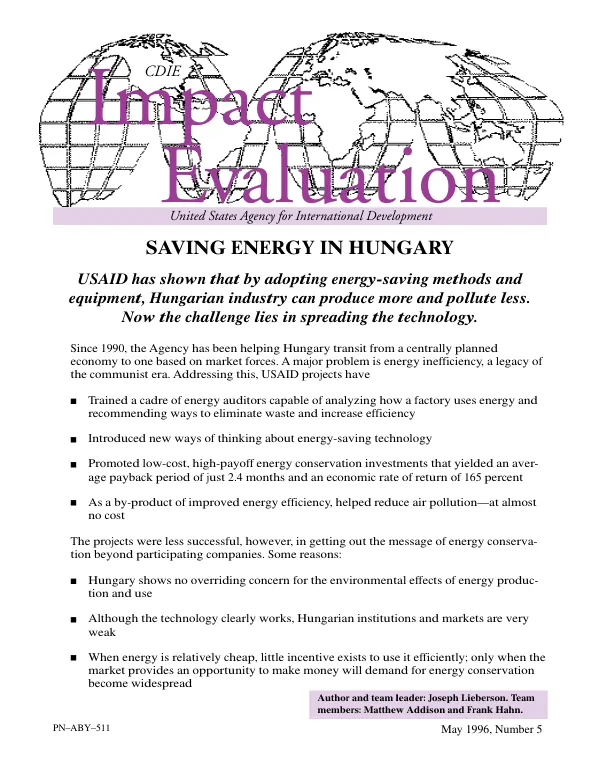
Since 1990, as part of its effort to help Hungary shift from a centrally planned to a market economy, USAID has undertaken projects to combat energy inefficiency, a legacy of the communist era.
Lieberson, Joseph M.|Addison, Matthew|Hahn, Frank · 1995
Sign in to readA free account is required to download.
Abstract
The projects, which targeted companies where energy is a major share of costs and which consequently had a strong incentive to make energy efficiency investments, demonstrated that energy conservation works. Factories that made investments were on average able to pay for their investments in just 2.4 months with the money saved by burning less fuel, and experienced a financial rate of return of 485%. Even from the perspective of the national economy, investments generated an economic rate of return of 165%. Moreover, the investments helped to reduce air pollution. The USAID projects were concerned not only with energy conservation "hardware" -- installing more efficient burners, motors, or pumps -- but with the even more important "software" issues of energy management; one of the most crucial aspects of the projects was the introduction of new ways of thinking about energy management, finance, production monitoring, and maintenance -- which is often more difficult than just buying a new motor. However, the projects were less successful in spreading the energy conservation message beyond the eight demonstration companies. Hungary shows no overriding concern for the environmental effects of energy production. Not only are Hungarian institutions and markets weak, but as long as energy is relatively cheap, there is little incentive to use it efficiently. Only when the market provides an opportunity to make money will the demand for energy conservation become widespread. (Author abstract, modified)
Related documents