USAID. MISSION TO MOROCCO
Energy demand management
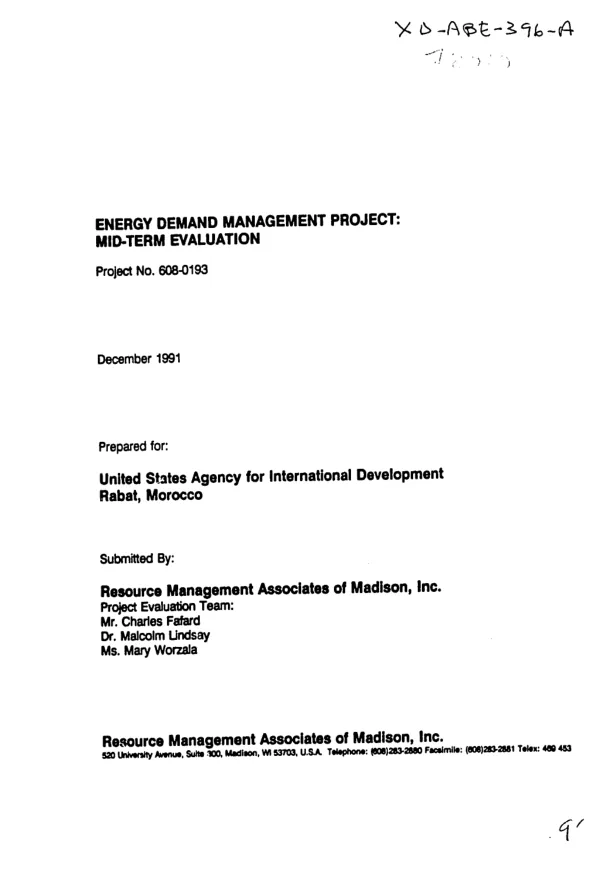
Summarizes mid-term evaluation (XD-ABE-396-A) of a project to improve energy demand management (EDM) by Morocco"s private sector.
1992
Sign in to readA free account is required to download.

Abstract
The evaluation covered the period 7/88-10/91. The project has made very good progress in improving energy efficiency and increasing the awareness of EDM techniques through information dissemination activities and the provision of high- quality technical services and training. Despite start-up problems and delays caused by the Gulf War, it is estimated that the project has saved the Moroccan private sector at least $1.9 million a year in energy costs. Information and awareness campaigns during the first part of the project were limited in order to avoid building up unrealistic expectations for the limited amount of TA available through the project. Interest in EDM by the Moroccan private sector has corresponded to business volume -- the higher the volume, the greater the interest. Personal contact has been the best dissemination tool. Technical support has included energy audits of target industries, boiler tune-ups, and electric bill analyses. Audit costs are shared incrementally by the private firms, beginning at 25% for the first year and ending at 100% for the fourth and future years; to date, the firms" portion of the cost-sharing has reached only about 18% due to problems with a previous employee of the contractor and a decision not to pressure the hotel industry (which is suffering from the impacts of the Gulf War) for payments. Nonetheless, such cost-sharing is a remarkable feat, given the sophistication of the Moroccan private sector. Because of the thoroughness of the audits, the project is behind schedule in meeting targets for both completed audits and project planning documents. Local engineers subcontracted by the project to assist in the audits are receiving excellent on-the-job training. As a result, the project will leave behind it a cadre of professional engineers. The project has conducted well-received workshops on energy audits, hotel energy management, construction materials, electrical bill analysis, and boiler operations. It has also helped develop a major in energy efficiency at the National School of Mining and Industry, and is planning to work with the Moroccan vocational training school on developing a curriculum for thermal operations. One barrier to training has been Moroccans" lack of English-language skills. Also, the entire 1991-92 winter training season was canceled due to the Gulf War. No policy studies have been conducted thus far, as there have been no requests for studies from the Government of Morocco (GOM). The key lesson learned is that the model of USAID working directly with the private sector, with the blessing of the GOM, is feasible. Another lesson is that market-driven demand for EDM services in Morocco is high -- so high that the contractor cannot fully respond, given current staff and financial resources. This strong demand is the ultimate sign of project success. A major action decision is to extend and increase funding for the project.
Related documents