ADVANCED ENGINEERING ASSOCIATES INTERNATIONAL, INC. /SGGA
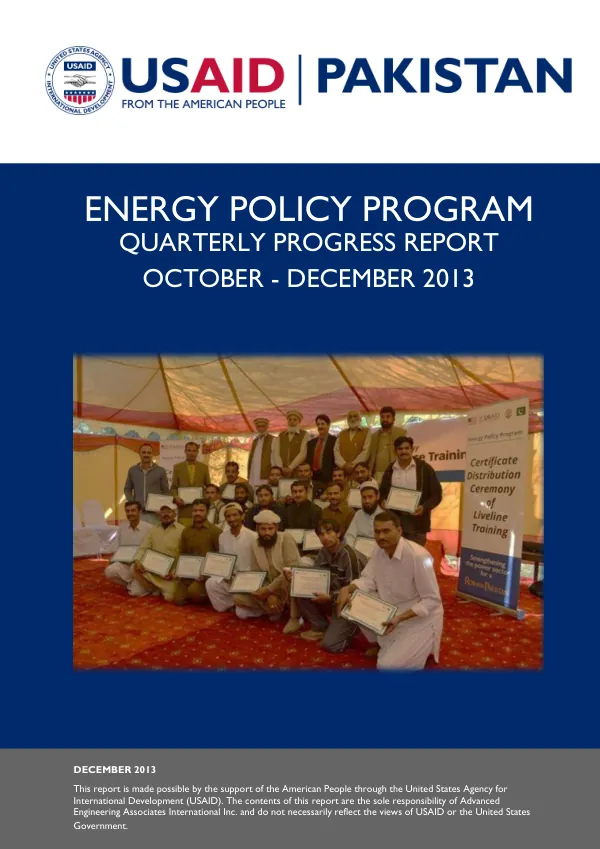
Energy Policy Program Quarterly Progress Report Oct - Dec 2013
The Energy Policy Program (EPP) is a multiyear, USAID-funded initiative to increase power generation, improve transmission, and enhance cost recovery in Pakistan.
2013 · 25 pages
Sign in to readA free account is required to download.
Abstract
EPP works with selected energy enterprises to assist the Government of Pakistan's sector reform efforts. The program supports the joint goals of the United States Government and the Government of Pakistan in reforming the power sector, and is designed to address Pakistan's chronic electricity shortage. EPP comprises four major components: Component 1, which provides monitoring and implementation support for six signature energy projects; Component 2, which supports generation and transmission-related studies and policy reform activities; Component 3, which conducts and prepares due diligence reports on new projects under consideration for USG support; and Component 4, which focuses on strengthening Pakistan's transmission network and fuel-mix diversification through support to energy import efforts. During the current phase of the EPP, which will conclude in October 2015, the program aims to add or restore 1,263 MW to the energy sector, contributing to an overall megawatt addition of 4,200 MW by 2017. As of the end of the third quarter of 2013, EPP had achieved significant progress in various areas, including generation, transmission, policy reform, and due diligence studies. In terms of generation, EPP had achieved 105.8% of its target, with 913 MW of power generated. In transmission, EPP had achieved 12% of its target, with 48 MW of transmission capacity added. In policy reform and governance, EPP had achieved 22.2% of its target, with 2 inputs provided. In due diligence and studies, EPP had completed 2 studies, and in G2G funding, EPP had achieved 93% of its target, with $132.08 million in funding secured. In procurement contracts, EPP had achieved 39% of its target, with $10.16 million in contracts awarded. EPP's capacity building program also facilitates sustainability by enhancing local capability in critical areas. The program's focus on strengthening Pakistan's transmission network and fuel-mix diversification through support to energy import efforts is expected to contribute to the overall goal of increasing power generation and improving transmission in the country. The EPP's current phase is expected to conclude in October 2015, with the anticipated goal of adding or restoring 1,263 MW to the energy sector, contributing to an overall megawatt addition of 4,200 MW by 2017. The program's progress in various areas, including generation, transmission, policy reform, and due diligence studies, is expected to continue in the coming months, with a focus on achieving the program's overall goals and objectives. EPP's activities are focused on several key areas, including the rehabilitation of Tarbela Hydropower Plant, the Gomal Zam Multipurpose Dam Project, the Satpara Multipurpose Dam Project, the Muzaffargarh Thermal Power Station Rehabilitation Project, the Jamshoro Thermal Power Station Rehabilitation Project, and the rehabilitation of Guddu Thermal Power Station. The program also supports the Ministry of Water and Power, the Ministry of Finance, the Ministry of Planning and Development, and the Ministry of Petroleum and Natural Resources in their efforts to reform the energy sector. Overall, the EPP is making significant progress in its efforts to increase power generation, improve transmission, and enhance cost recovery in Pakistan. The program's focus on strengthening Pakistan's transmission network and fuel-mix diversification through support to energy import efforts is expected to contribute to the overall goal of increasing power generation and improving transmission in the country.
Related documents