USAID
Energy Policy Project
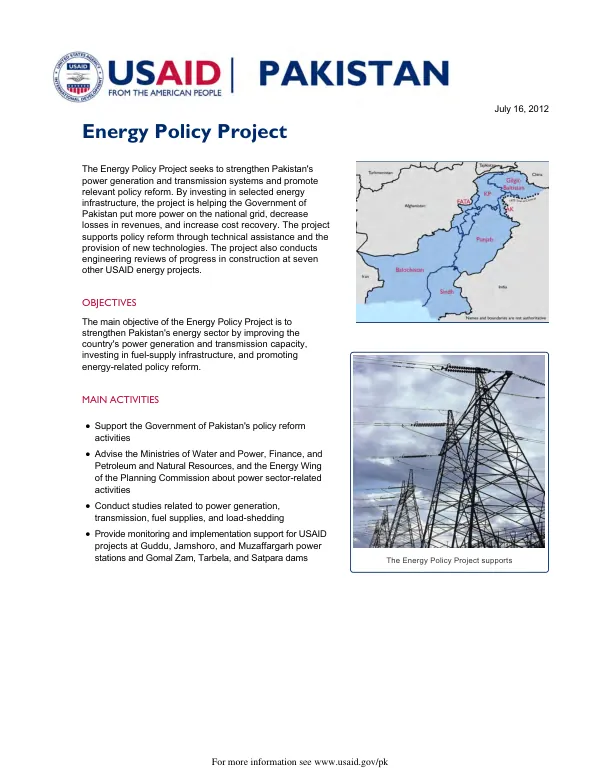
The Energy Policy Project in Pakistan aims to strengthen the country's power generation and transmission systems, as well as promote relevant policy reform.
2012 · 2 pages
Sign in to readA free account is required to download.
Abstract
By investing in selected energy infrastructure, the project is helping the Government of Pakistan put more power on the national grid, decrease losses in revenues, and increase cost recovery. The project supports policy reform through technical assistance and the provision of new technologies. The main objective of the Energy Policy Project is to strengthen Pakistan's energy sector by improving the country's power generation and transmission capacity, investing in fuel-supply infrastructure, and promoting energy-related policy reform. To achieve this objective, the project focuses on several key activities, including supporting the Government of Pakistan's policy reform activities, advising various ministries and the Energy Wing of the Planning Commission on power sector-related activities, conducting studies related to power generation, transmission, fuel supplies, and load-shedding, and providing monitoring and implementation support for USAID projects at various power stations and dams. The project has made significant progress to date, with three energy-sector entities strengthened through pre-rehabilitation audits and business plans. Analysis has been conducted on the economic value of natural gas in various sectors, and a renewable energy policy has been developed to promote the use of alternate sources of energy. Additionally, 110 employees have been trained in improved operational and maintenance techniques for hydro- and thermal power stations. A policy paper has been completed on public-private partnerships in the energy sector, and technical support has been provided to the National Electric Power Regulatory Agency. Environmental impact assessment guidelines have been completed for wind power projects, and an energy efficiency and conservation act has been facilitated, which created an apex governmental body on energy conservation. The project's geographic focus is on Pakistan, with a specific emphasis on the country's power generation and transmission systems. The project's implementation details are centered around supporting the Government of Pakistan's policy reform activities, advising various ministries and the Energy Wing of the Planning Commission, conducting studies, and providing monitoring and implementation support for USAID projects. The project's timeframes are not explicitly stated, but the results to date suggest that the project has been ongoing for several years, with a focus on achieving its objectives and making a positive impact on Pakistan's energy sector. The project's recommendations are not explicitly stated, but the results to date suggest that the project has been successful in achieving its objectives and making a positive impact on Pakistan's energy sector. The project's focus on policy reform, technical assistance, and the provision of new technologies has helped to strengthen Pakistan's energy sector, improve the country's power generation and transmission capacity, and promote energy-related policy reform.
Related documents