GOVERNMENT OF TAJIKISTAN
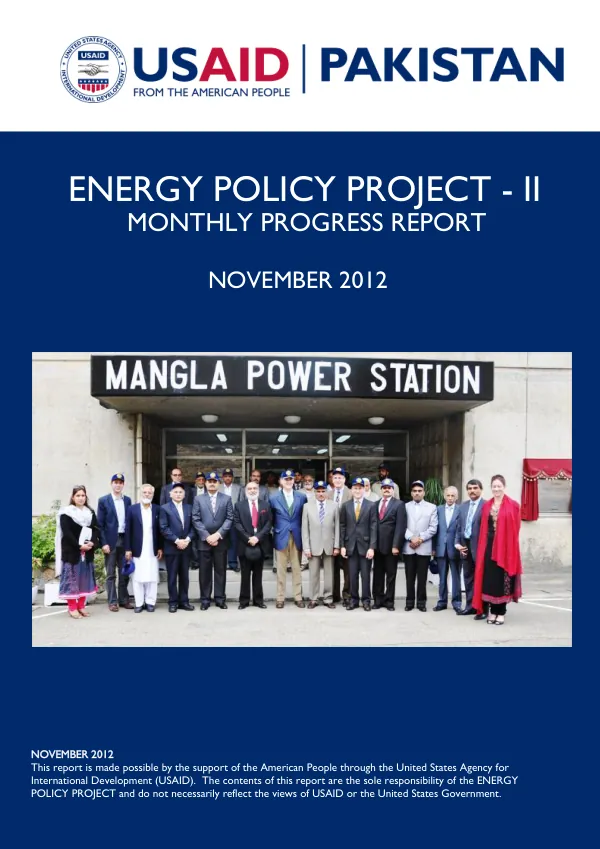
ENERGY POLICY PROJECT - II MONTHLY PROGRESS REPORT NOVEMBER 2012
The Energy Policy Project (EPP) supports the jointly agreed upon interests of USAID and the Government of Pakistan in power generation and transmission and related policy reform activities.
2012 · 32 pages
Sign in to readA free account is required to download.
Abstract
Current key activities include providing monitoring and implementation support to six signature energy projects announced by Secretary of State Hillary Clinton. These projects include rehabilitation of three thermal power plants (Muzaffargarh, Guddu, and Jamshoro) and one hydropower plant (Tarbela dam), as well as construction of two new multipurpose dams (Gomal Zam Dam and Satpara Dam). Total USG funding for these projects is $136.731 million, with estimated gains in available generating capacity up to 863MW. As of November 2012, 439MW have been added to Pakistan's national grid. The EPP is also providing technical support to the Ministry of Water and Power (MWP) to identify and select new generation and transmission projects. Examples include potential imports of electricity from the Central Asian Republics to Pakistan through Afghanistan and providing analytical support for projects such as the Kurram Tangi Project. The EPP is supporting generation and transmission-related studies and policy reform activities assigned by USAID. These include developing GENCO and NTDC business plans, developing policies and procedures for the National Power Control Center, and advisory services at MWP and the Planning Commission (Energy Wing), Ministry of Finance (MOF), and Ministry of Petroleum and Natural Resources (MPNR). The EPP is providing monitoring and implementation support for the six signature projects announced by Secretary of State Hillary Clinton. These projects include rehabilitation of three thermal power plants (Muzaffargarh, Guddu, and Jamshoro) and one hydropower plant (Tarbela dam), as well as construction of two new multipurpose dams (Gomal Zam Dam and Satpara Dam). Total USG funding for these projects is $136.731 million, with estimated gains in available generating capacity up to 863MW. As of November 2012, 439MW have been added to Pakistan's national grid. The rehabilitation of Tarbela hydropower plant is underway, with a total funding of $82.5 million. The project aims to add up to 163MW of generation through the rehabilitation of Tarbela hydropower plant and completion of two multipurpose dams, Satpara and Gomal Zam. A baseline condition of the dams is tabulated below. The EPP has reviewed progress on the completion of the rehabilitation work at Tarbela Power Plant and urged the plant management to expedite completion of the work. Discussions were also held on the training requirements of the WAPDA staff. The complete equipment under FARA item 6 (digital governors) was received at the site, and EPP certified the Tarbela Units under Rehabilitation Baseline at the time of FARA signing and Baseline at shut down for replacement. The EPP has coordinated and supported WAPDA in preparing responses to observations made by the GOP and USAID OIG auditors. Amendment-I of the Tarbela FARA has revised the completion date of the project to December 31, 2012. Of the $16.5 million USG funding committed for Tarbela, total disbursement as of November 2012 is $13,949,917. The current status of the Tarbela FARA is tabulated below. The EPP is providing technical support to the Ministry of Water and Power (MWP) to identify and select new generation and transmission projects. Examples include potential imports of electricity from the Central Asian Republics to Pakistan through Afghanistan and providing analytical support for projects such as the Kurram Tangi Project. The EPP is also supporting generation and transmission-related studies and policy reform activities assigned by USAID. The EPP is comprised of 85% Pakistani and 15% international staff. The project is located in all provinces and Federally Administered Tribal Areas. Total USAID funding for the project is $136.731 million for six signature energy projects and $14.893 million for EPP Phase II.