USAID
Enhancing Participatory Governance and Accountability
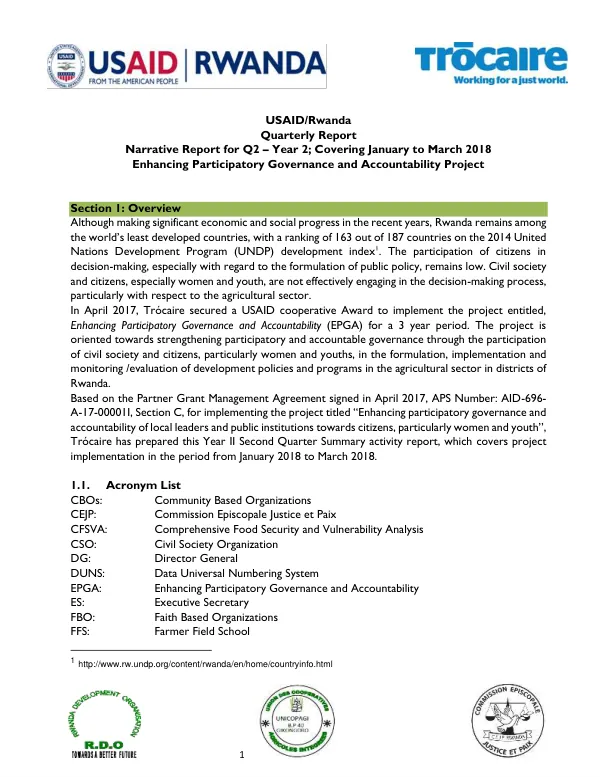
The Enhancing Participatory Governance and Accountability Project in Rwanda aims to strengthen participatory and accountable governance through the participation of civil society and citizens, particularly women and youth, in the formulation, implementation, and monitoring/evaluation of development policies and programs in the agricultural sector.
2018 · 29 pages
Sign in to readA free account is required to download.
Abstract
The project is implemented by Trócaire in partnership with Rwanda Development Organization (RDO), Commission Episcopale Justice et Paix (CEJP-Rwanda), and Union des Coopératives Agricoles Intégrées (UNICOOPAGI) in five districts of Rwanda. The project's focus areas include raising awareness and enhancing the knowledge of citizens, especially women and youth, on agricultural policies, programs, and their related budgets; increasing the capacity of civil society organizations in policy and budget analysis; and supporting local authorities in the five districts to better engage with citizens and civil society. The project's major outcomes include empowered citizens, particularly women and youths, who are able to engage in agricultural policy and budget monitoring and hold public authorities accountable; increased capacity of civil society and community committees to engage in policy analysis, budget monitoring, and advocacy; and improved capacity of local authorities to engage and respond to priorities expressed by citizens and civil society. During the second quarter of Year 2, the project implemented various activities, including a national policy dialogue that brought together over 60 national and international NGOs, as well as policy makers from the relevant Ministries, including the Ministry of Agriculture and Animal Resources. Additionally, 20,000 additional copies of booklets on citizens' role and responsibilities in policy and budget monitoring to agriculture were printed due to their huge demand. The project also reached and informed the wider communities in the target districts about the knowledge gained so far through feedback meetings held with community committee members at village level in 63 villages in five target districts. The project's major achievements in the second quarter include the implementation of most planned activities, which have contributed to enhancing participatory governance and accountability in the community, especially among farmers and local authorities. Citizens' reactions and farmers' wishes show that there are changes that have been realized through farmers/citizens' enhanced knowledge and skills on roles and responsibilities in policy formulation and implementation processes. However, the project faced some challenges, including unrealistic budget allocation on some budget lines, difficulties in responding to requests from local authorities and beneficiaries following the implementation of project activities, and low involvement of youth in agricultural-related matters due to their lack of land resources. To address these challenges, the project proposed solutions, including preparing a budget reallocation for discussion with USAID and approval as required, considering the inclusion of new activities that contribute to the project outcomes where the budget allows it, and assessing the possibilities to engage in agricultural value chain rather than in crop production.
Related documents