ASSOCIATES FOR INTERNATIONAL RESOURCES AND DEVELOPMENT (AIRD)
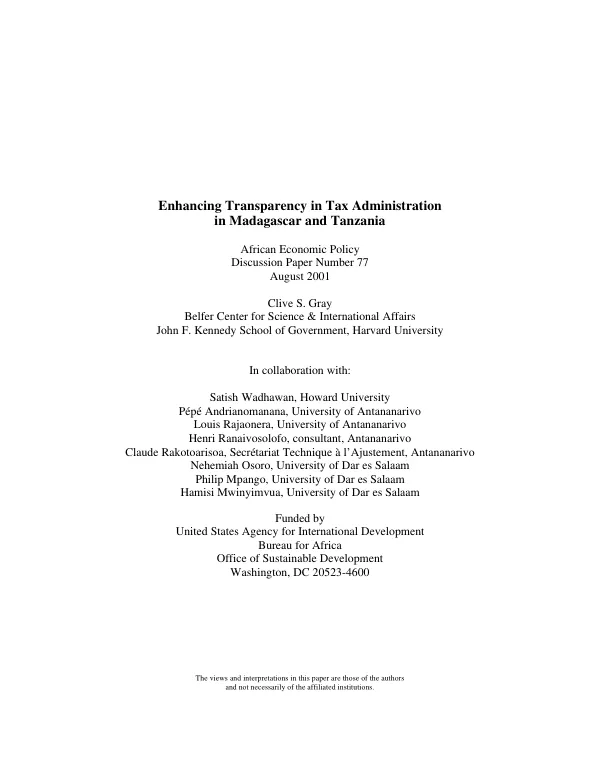
Enhancing transparency in tax administration in Madagascar and Tanzania
The following is the final report for research conducted under the Equity and Growth Through Economic Research (EAGER) project in Madagascar and Tanzania on tax administration transparency.
Gray, Clive S. · 2001
Sign in to readA free account is required to download.
Abstract
The study sets out to show stakeholders and policymakers the following: (1) Evasion of many major taxes can be estimated systematically on the basis of economic parameters, allowing an aggregate estimate of the proportion of potential government revenue that is foregone through evasion. (2) The margin of error of the estimation is narrow enough to say whether evasion of a particular tax is going up or down over time. (3) The taxpaying public is conscious of the phenomenon of evasion, and its acceptance of responsibility for helping to finance government expenditure is affected negatively by a perception that individuals and groups with political and/or financial influence engage in massive evasion of taxes to which they are liable. (4) Tax officials are likewise conscious of the phenomenon, and their perceptions of evasion rates are consistent with estimates based on economic analysis. Moreover, their diligence in collecting taxes due is affected negatively by perceptions that: (a) some of their peers and superiors accept bribes for collecting less than the full amounts due, and (b) politicians use their influence to protect major evaders, including themselves. The research confirms that, while many stakeholders acknowledge tax evasion as a significant factor in macroeconomic weakness and deficit funding of social services, the responsible officials are reticent to estimate and publicize the extent of evasion and expose the most prominent evaders. By thus lending credibility to its underlying hypotheses, the study supports the call to the tax authorities in the subject countries, and by extension elsewhere in Africa, to treat transparency in its various dimensions as a tool for improving compliance. This in turn will enhance the role of African tax systems in supporting macroeconomic stability and in extending provision of public services. (Author abstract, modified)
Related documents
![Enhancing transparency in tax administration in Tanzania : EAGER/PSGE [Private Sector Growth and Environment Division] final report](https://covers.devme.ai/gen/37348.webp)