HARVARD UNIVERSITY. HARVARD INSTITUTE FOR INTERNATIONAL DEVELOPMENT (HIID)
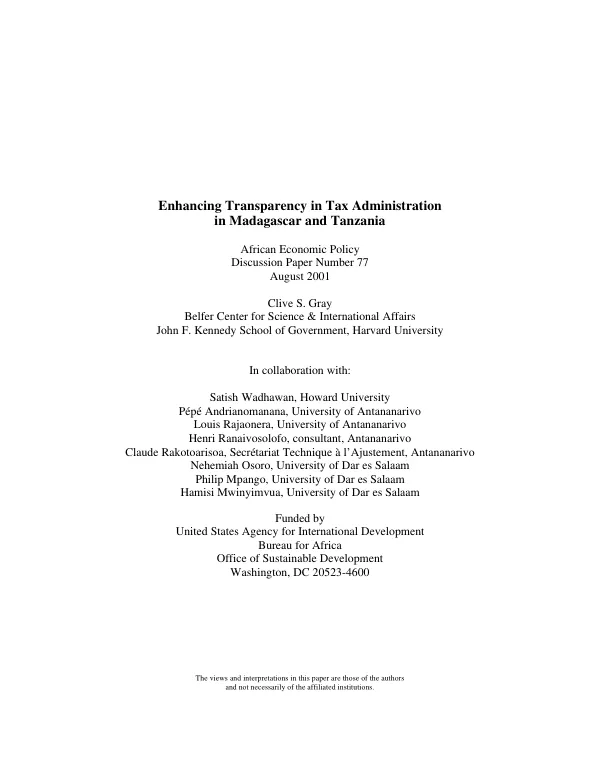
Enhancing transparency of tax administration
Pervasive tax evasion threatens the fairness and efficiency of the tax system in sub-Saharan Africa, creating a vicious cycle in which differences in taxpayer compliance increases the tax burden, which in turn undermines citizens" confidence in the fiscal system and their willingness to comply.
Wadhawan, Satish C.; Gray, Clive · 1996
Sign in to readA free account is required to download.
Abstract
Transparency of tax administration can help break this cycle and strengthen the revenue performance of sub-Saharan countries. Using Tanzania and Madagascar as case studies, this paper reviews tax systems, tax compliance, and tax evasion in the region, as well as the main facets of transparency that are critical to improving revenue performance. The following policies or procedures are recommended. (1) Improve education and services for taxpayers, including taxpayer interface with the tax system, and assistance for non-literate taxpaying populations. (2) Establish a tax ombudsman office to receive and process taxpayer complaints about their treatment and assess openly the evenness of compliance and enforcement, thus laying a basis for increasing taxpayers" willingness to comply. (3) Abolish most discretionary tax exemptions accorded by the executive branch or legislature, and publicize ad hoc exemptions, especially from tax holidays, import duties, value-added tax (VAT), and sales and excise taxes. The true costs of these exemptions should also be assessed. (4) Require foreign agencies, which sometimes claim diplomatic privilege or understate rentals in order to avoid increases, to provide information about their consumption of taxable goods and services. (5) Measure components of the tax base and collections in relation to the base, and regularly publish the findings. (6) Provide detailed indicators of the performance of the revenue service, including the number of returns the service has processed from businesses in various categories in a particular year. (7) Improve external transparency, e.g., by informing the public of the social costs of a large budget deficit, publicizing the issue through the press, and conducting public opinion surveys. (8) Improve the quantity and quality of the information available to tax administration. (9) Involve local economists in transparency issues and encourage them to publicize findings. Directions for further research are noted in conclusion. Includes bibliography.
![Enhancing transparency in tax administration in Tanzania : EAGER/PSGE [Private Sector Growth and Environment Division] final report](https://covers.devme.ai/gen/37348.webp)