ICF
Enquête Démographique et de Santé à Madagascar (EDSMD-V) 2021
The L'Enquête Démographique et de Santé à Madagascar (EDSMD-V 2021) was conducted in March 2020, but due to COVID-19, it was interrupted and resumed from March to July 2021 by the Institut National de la Statistique (INSTAT) in collaboration with the Ministère de la Santé Publique (MINSANP).
2021 · 2 pages
Sign in to readA free account is required to download.
Abstract
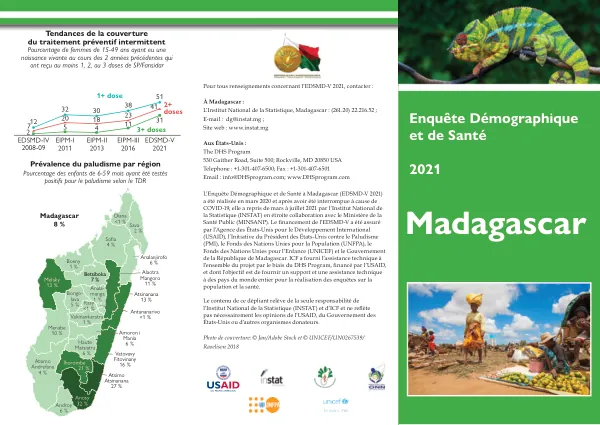
The survey was funded by the Agence des États-Unis pour le Développement International (USAID), the Initiative du Président des États-Unis contre le Paludisme (PMI), the Fonds des Nations Unies pour la Population (UNFPA), the Fonds des Nations Unies pour l'Enfance (UNICEF), and the Gouvernement de la République de Madagascar. ICF provided technical assistance to the project through the DHS Program, funded by the USAID, which aims to provide support and technical assistance to countries worldwide for population and health surveys. The survey provides data for tracking and evaluating the health situation in Madagascar. The results are representative at the national level, as well as for urban and rural areas, and for the 22 regions of Madagascar and the capital, Antananarivo. The survey collected data from 20,510 households, with a response rate of 99%. A total of 18,869 women aged 15-49, 9,037 men aged 15-59, and 20,510 households were interviewed. The survey found that 49% of children aged 12-23 months had received all eight basic vaccines. The average woman in Madagascar has 4.3 children throughout her reproductive life. The survey also found that 43% of women aged 15-49 used some form of family planning, with 50% using modern methods, including injectables, implants, and the pill. However, 3% of women used traditional methods. The survey also collected data on infant and child mortality, with a mortality rate of 57 deaths per 1,000 live births for the five years preceding the survey. The survey found that 40% of children under five had stunted growth, 23% had low weight for their age, and 2% had excessive weight for their age. The survey also found that 32% of women had heard of cervical cancer and 1% had undergone a test for cervical cancer. The survey provides data on the prevalence of malaria by region, with the highest prevalence found in the Anosy region at 32%. The survey also found that 43% of women aged 15-49 used some form of family planning, with 50% using modern methods. The survey provides data on the use of improved water sources, sanitation facilities, and electricity, with 48% of households in urban areas and 38% in rural areas having access to improved water sources. The survey also found that 39% of women aged 15-49 used injectables, 27% used implants, and 10% used the pill as a modern method of family planning. The survey provides data on the trends in the coverage of intermittent preventive treatment for pregnant women, with a coverage rate of 20% in 2021, compared to 18% in 2013 and 38% in 2016. The survey also found that 94% of women aged 15-49 had heard of HIV/AIDS, and 72% had heard of the disease in the past year.
Related documents