EUROPEAN UNION
Enquête Démographique et de Santé en Mauritanie 2019-2021
The Enquête Démographique et de Santé en Mauritanie 2019-2021 was conducted by the Office National de la Statistique (ONS) in close collaboration with the Ministère de la Santé (MS).
2021 · 2 pages
Sign in to readA free account is required to download.
Abstract
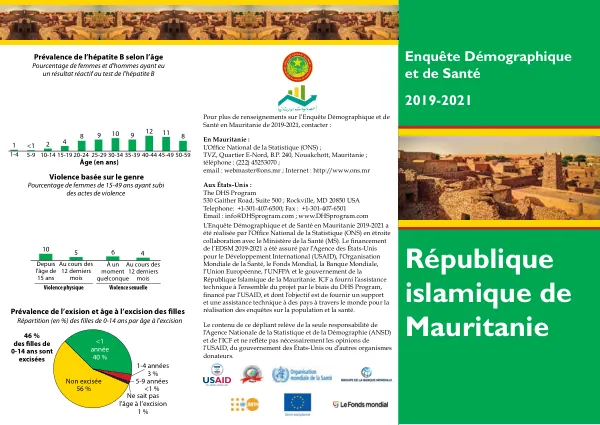
The survey was funded by the Agence des États-Unis pour le Développement International (USAID), the Organisation Mondiale de la Santé, the Fonds Mondial, the Banque Mondiale, the Union Européenne, the UNFPA, and the government of the République Islamique de la Mauritanie. ICF provided technical assistance to the project through the DHS Program, funded by the USAID, with the objective of providing support and technical assistance to countries worldwide for the realization of population and health surveys. The survey aimed to provide data for monitoring and evaluating the health situation in Mauritania. The Enquête Démographique et de Santé en Mauritanie 2019-2021 is the second demographic and health survey in Mauritania. The results of the survey are representative at the national level, as well as for urban and rural areas, and for the wilayas of Mauritania. The survey covered a total of 11,658 households, with a response rate of 99% for households, 96% for women aged 15-49, and 92% for men aged 15-59. The survey found that, on average, a woman in Mauritania has 5.2 children throughout her reproductive life. The survey also reported that 80% of households in Mauritania have access to improved drinking water sources, while 90% of households in urban areas and 86% of households in rural areas have access to improved sanitation facilities. The survey also found that 13% of women aged 15-49 in union use any contraceptive method, while 14% use a modern contraceptive method. The survey reported that, for every 100,000 live births, 424 women die during pregnancy, childbirth, or within 42 days after delivery. The survey also found that 38% of children aged 12-23 months have received all 8 basic vaccinations. The survey reported that 70% of births in Nouakchott and 98% of births in Dakhlet Nouadhibou and Tiris Zemour and Inchiri took place in a health facility. The survey also reported on the nutritional status of children, with 26% of children under 5 years old having a height too small for their age, 6% having a weight too low for their height, and 2% having a weight too high for their height. The survey also reported on infant and juvenile mortality rates, with 38 deaths per 1,000 live births in Nouakchott, 42 deaths per 1,000 live births in Tiris Zemour and Inchiri, and 85 deaths per 1,000 live births in Adrar.