USAID DEC
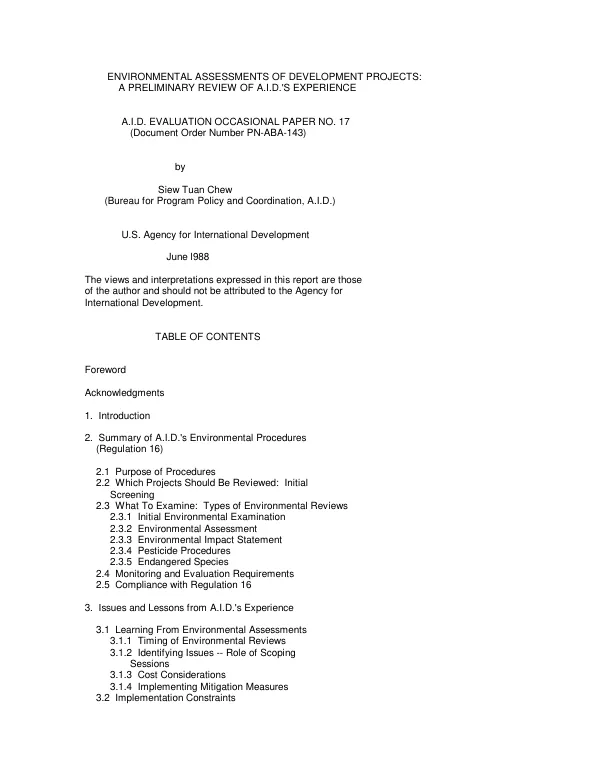
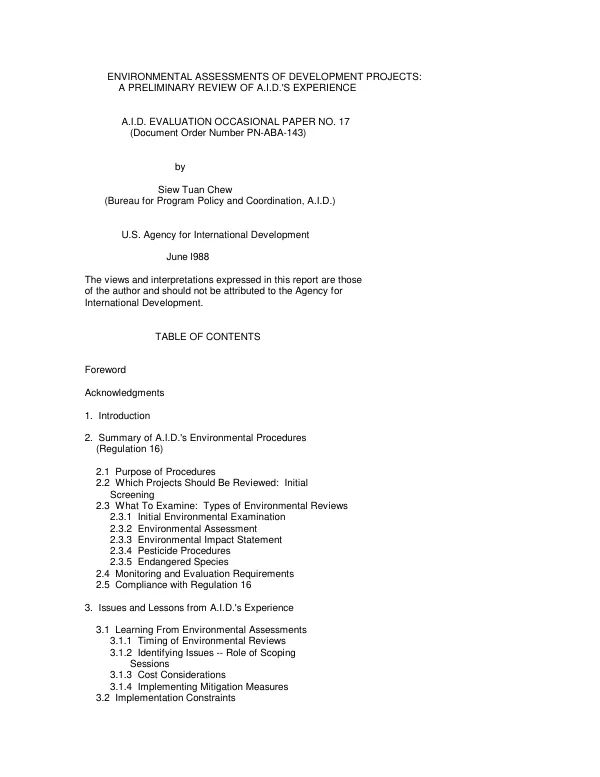
Environmental assessments of development projects : a preliminary review of AID"s experience
Sign inUSAID. BUR. FOR PROGRAM AND POLICY COORDINATION. CENTER FOR DEVELOPMENT INFORMATION AND EVALUATION (CDIE)
Environmental assessments of development projects : a preliminary review of AID"s experience
Since the late 1970"s donors and host country governments alike have become concerned with reversing the environmental degradation taking place in many Third World nations and limiting the adverse impact of development projects on the environment.
Chew, Siew Tuan · 1988
Sign in to readA free account is required to download.
Abstract
This study describes, and reviews the effectiveness of, A.I.D."s system for assessing the potential environmental impacts of proposed projects. Using examples of projects that were revised after environmental review, the study discusses A.I.D."s methods for classifying the environmental risks of development projects (the so-called black, grey, and white lists), and the impact of the assessment process on revising project designs and implementaton. Experience indicates that in many cases the assessments have helped project designers to identify and address significant environmental issues, and that they provide a forum for host country officials to voice their concerns about project impacts. The system is less effective, however, in screening activities indirectly funded by A.I.D. (e.g., activities of A.I.D.-supported intermediary credit institutions) and it does not provide guidance on how to detect or address unforeseen negative effects that might occur during implementation. Another potential problem is that budget-conscious Missions, fearing expensive project redesigns, might avoid the process altogether by funding only those projects on the "white list," i.e., that qualify for a categorical exclusion.
Connected topics