DA AFGHANISTAN BRESHNA SHERKAT
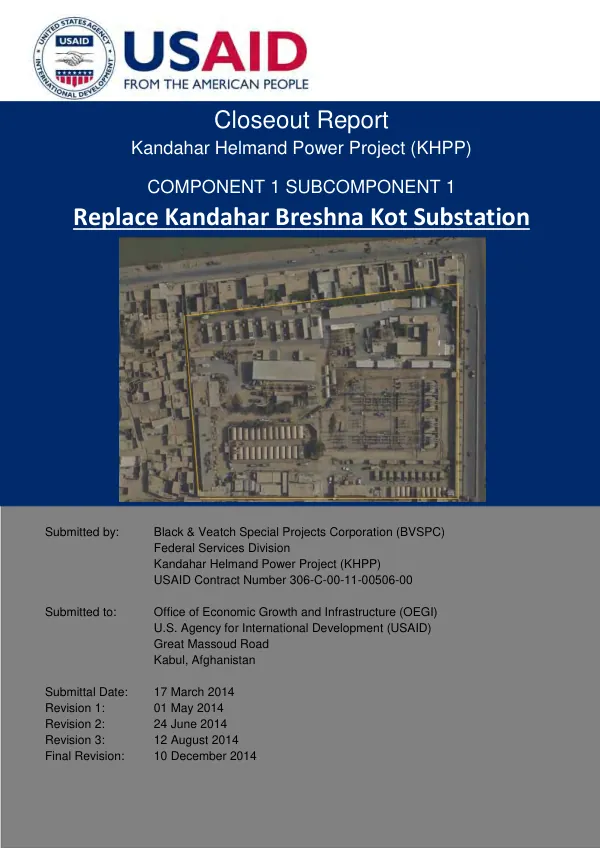
Environmental Close-Out Report for Kandahar Helmand Power Project (KHPP)
The Kandahar Helmand Power Project (KHPP) is a power generation and transmission project located in Kandahar and Helmand provinces, Afghanistan.
2014 · 66 pages
Sign in to readA free account is required to download.
Abstract
The project was implemented by Black & Veatch Special Projects Corporation, with funding from the U.S. Agency for International Development (USAID). The project's primary objective was to improve the power supply in the region, with a focus on increasing the reliability and efficiency of the power grid. The project was divided into several components, including the Breshna Kot site, the Durai Junction Substation, the Project Management Camp, the Shorandam Industrial Park Diesel Power Plant, and the Kajaki Unit 2. Each component was designed to address specific environmental and social impacts associated with the project. The Breshna Kot site, which includes the KDEG and KDBK portions of the contract, did not experience any significant environmental impacts during the project period. However, a critical issue related to PCB-contaminated soils was identified, and a containment cell was designed and constructed to manage the potential impacts. The cell was designed to meet the standards outlined in 40 CFR Part 257, and it was completed on September 8, 2013. The Durai Junction Substation, a new construction substation located in Kandahar Province, did not encounter any significant environmental impacts since construction commenced. However, a few potential issues were identified and mitigated through engineering controls and construction management. These issues included the lack of secondary containment for the generators' fuel tanks, open tower foundation excavations outside the site perimeter, and trash disposal of construction debris. The Project Management Camp, located in Amtex Village, was a pre-constructed accommodation complex constructed by others, with portions leased by Black & Veatch. One major component of the complex that B&V was responsible for was the 10.4-acre lay-down yard, which was constructed by and utilized solely by B&V. There was one report of a potential environmental impact during the time that B&V occupied the area, related to a shipping container with oil leaking from it. Personnel immediately addressed the issue, and the area was cleaned up. The Shorandam Industrial Park Diesel Power Plant was designed to meet the power needs of the industrial park, with a focus on reducing emissions and improving efficiency. The plant was equipped with low-emission, low-noise, and diesel-powered MTU generators, which were designed to meet Tier 2 requirements. A comparison of the emission calculations for the new and existing generators showed an approximate reduction of 37.79% in emissions. The Kajaki Unit 2 was a major component of the project, designed to increase the power generation capacity of the Kajaki Dam. The unit was equipped with a low-emission, low-noise, and diesel-powered MTU generator, which was designed to meet Tier 2 requirements. The unit was constructed and commissioned in accordance with the project's environmental and social impact assessment. Overall, the KHPP project was designed to improve the power supply in the region, with a focus on increasing the reliability and efficiency of the power grid. The project's environmental and social impacts were managed through a comprehensive environmental mitigation and management plan, which was implemented throughout the project period.