USAID DEC
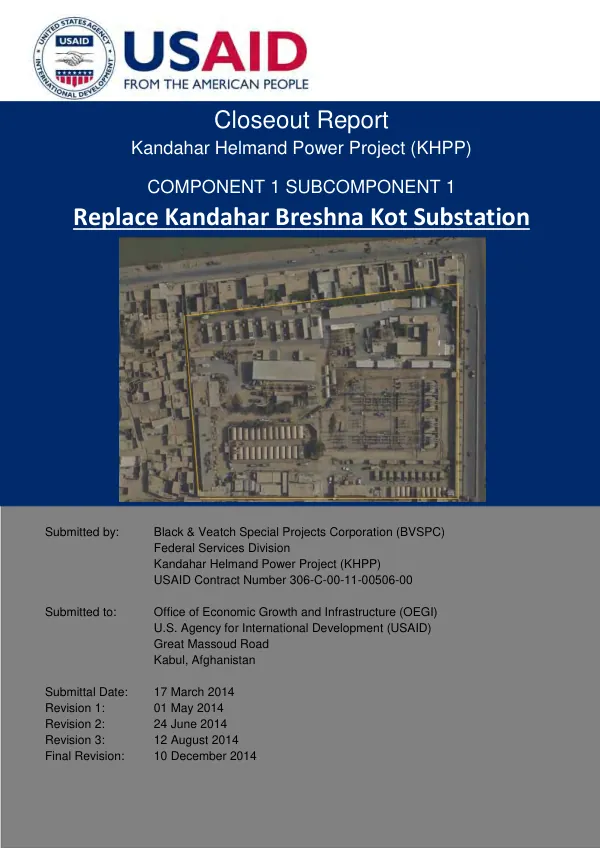
Closeout Report: Kandahar Helmand Power Project (KHPP) Subcomponent 1.1 - KDBK Closeout Report
Sign inDA AFGHANISTAN BRESHNA SHERKAT
Closeout Report: Kandahar Helmand Power Project (KHPP) Subcomponent 1.1 - KDBK Closeout Report
The Kandahar Helmand Power Project (KHPP) is a USAID-funded initiative aimed at improving the power infrastructure in southern Afghanistan.
2014 · 53 pages
Sign in to readA free account is required to download.
Abstract
The project's primary objective is to increase the reliability and efficiency of the power grid in the region, thereby enhancing economic growth and development. The KHPP Subcomponent 1.1, Replace Kandahar Breshna Kot Substation, is a key component of the project, focusing on the replacement of the existing Kandahar Breshna Kot Substation. The subcomponent's objectives include replacing the substation while maintaining existing service for customers, coordinating with Da Afghanistan Breshna Sherkat (DABS) for removal of obsolete equipment and existing facilities, and ensuring that the new substation meets the required standards. The project's history dates back to 2013, with the initial contract awarded to Black & Veatch Special Projects Corporation (BVSPC) in March 2013. The contract underwent several modifications, with the final modification issued in February 2014. The project's implementation involved a range of activities, including the replacement of the substation, installation of new equipment, and training of local personnel. The project's organizational structure consisted of a project management team, led by BVSPC, and a range of subcontractors and consultants. The project's budget was approximately $10 million, with the majority of funds allocated to the replacement of the substation and installation of new equipment. The project's physical completion was achieved in December 2014, with the new substation commissioned and operational. The project's sustainability was ensured through a range of activities, including offsite and onsite training of local personnel, development of operations and maintenance manuals, and implementation of a quality control plan. The project's safety program and incident reports were also a key focus area, with regular safety audits and incident reports submitted to the project management team. The project's environmental control plan was also implemented, with regular environmental monitoring and reporting. The project's closeout report, submitted in December 2014, provided a comprehensive overview of the project's progress, achievements, and lessons learned. The report highlighted the project's successes, including the replacement of the substation, installation of new equipment, and training of local personnel. The report also identified areas for improvement, including the need for more effective communication and coordination between stakeholders. The project's impact assessment revealed a significant improvement in the power infrastructure in southern Afghanistan, with the new substation providing reliable and efficient power supply to customers. The project's sustainability was ensured through a range of activities, including offsite and onsite training of local personnel, development of operations and maintenance manuals, and implementation of a quality control plan. The project's closeout report also highlighted the importance of effective project management, coordination, and communication in achieving project success. The report recommended that future projects adopt a similar approach to project management, with a focus on effective communication, coordination, and stakeholder engagement. The project's overall impact was significant, with the new substation providing reliable and efficient power supply to customers, thereby enhancing economic growth and development in southern Afghanistan. The project's sustainability was ensured through a range of activities, including offsite and onsite training of local personnel, development of operations and maintenance manuals, and implementation of a quality control plan.