TRAINING RESOURCES GROUP – TRG
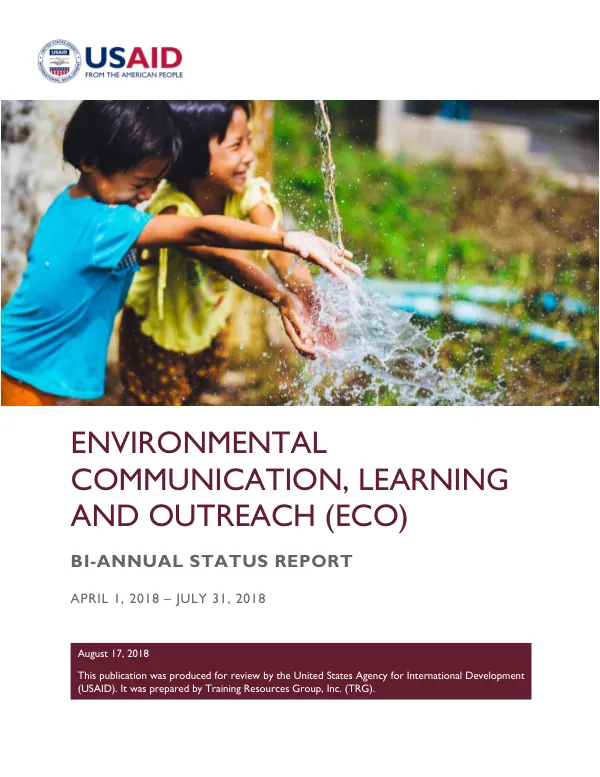
Environmental Communication, Learning, and Outreach (ECO) Semi-Annual Report
The Environmental Communication, Learning, and Outreach (ECO) program began in October 2013 as part of the Bureau of Economic Growth, Education and Environment's (E3) efforts to meet USAID objectives in training, communication, knowledge management, and facilitation in the Environment and Natural Resources Management (ENRM) sector and Global Climate Change (GCC) issue area.
2014 · 22 pages
Sign in to readA free account is required to download.
Abstract
The two primary ECO program objectives are to provide USAID staff and the broader development community with the requisite knowledge, skills, and abilities to design, implement, monitor, and evaluate quality programs, and to develop and enhance communications and information management systems that facilitate knowledge sharing and learning for improved development impact. The ECO implementation team is currently comprised of Training Resources Group, Inc. (TRG), Engility/IRG, and Forum One Communications. The team has made significant strides in establishing the framework and systems to support the management of the project, including increasing staffing to meet the project's expanded needs, establishing a budget monitoring system, and putting in place information sharing systems using the web-based platform Basecamp. The Learning Needs Assessment (LNA) process has been a key accomplishment for the ECO team. The LNA objectives were to determine learning required for/desired by target audiences to effectively design, implement, and monitor GCC, Water, and Environment and Natural Resources Management programs according to current competencies and future needs. The LNA methodology was defined and approved, and a comprehensive draft report was submitted to the USAID ECO Team on March 31, 2014. The data produced formed the basis for creating the ECO Learning Strategy. The LNA data collection process included a survey comprised of 55 questions that was launched on February 13, 2014, reaching about 1500 USAID staff. The total number of respondents to the survey was 460. Interviews and focus groups were also conducted, with 14 focus groups and 23 interviews. The data provides an assessment in 40 competencies as well as for specific skills and knowledge of global climate change and water technical areas. The ECO team has also implemented the first ECO training course in Lima, Peru, which focused on the integration of global climate change across sectors and was for a non-environment audience. The course had the following objectives: articulate how climate change relates to development work in multiple sectors, understand the concepts of climate change adaptation and low emission development strategies, describe USAID's Global Climate Change funding pillars' goals and activities, and identify and take next steps to integrate climate change into one's own work. The ECO team has also made significant strides in establishing the framework and systems to support the management of the project, including increasing staffing to meet the project's expanded needs, establishing a budget monitoring system, and putting in place information sharing systems using the web-based platform Basecamp. The team has also implemented the first ECO training course in Lima, Peru, which focused on the integration of global climate change across sectors and was for a non-environment audience. The ECO team has also conducted a rapid communications and knowledge management assessment of the RM Portal, which generated a series of recommendations to improve the user experience that are being implemented by the RM Portal Administrator. The team has also finalized the data collection phase of the LNA, with a comprehensive draft report submitted to the USAID ECO Team on March 31, 2014. The data produced formed the basis for creating the ECO Learning Strategy.