USAID DEC
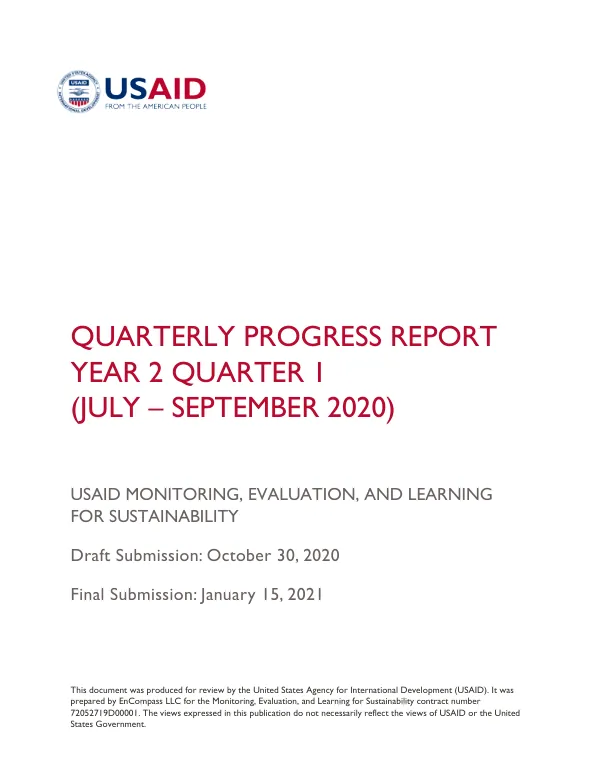
USAID Monitoring, Evaluating and Learning for Sustainability Quarterly Progress Report
Sign inENCOMPASS, LLC
USAID Monitoring, Evaluating and Learning for Sustainability Quarterly Progress Report
The Monitoring, Evaluation, and Learning for Sustainability (MELS) Activity is a USAID-funded initiative aimed at elevating the caliber of evidence-based decision making in Peru.
2020 · 68 pages
Sign in to readA free account is required to download.
Abstract
The central focus of the MELS Activity is to build local stakeholders' self-reliance to carry out meaningful monitoring and evaluation (M&E) going forward. Through the support of the MELS Activity, local development practitioners are envisioned to use evidence to design and implement programming focused on building local ownership and advancing the sustainability of development outcomes. The MELS Activity implements services across four components: Component 1, which focuses on increased use of evaluations and assessment results among USAID and external stakeholders for program decisions; Component 2, which aims to increase the use of monitoring data among USAID and Implementing Partners (IP) for program decisions; Component 3, which seeks to strengthen government M&E capacity for learning and accountability; and Component 4, which aims to strengthen and sustainable collaboration, learning, and knowledge management for greater sustainability of outcomes. In the first quarter of year 2, the MELS Activity made progress against these components and in responding to management and operations tasks. Implementation progress is reported below. The MELS Activity has made significant progress in building local stakeholders' self-reliance to carry out meaningful M&E. The team has initiated internal and external Pause and Reflect sessions, which led to the identification of key successes and areas for improvement. The COVID-19 pandemic continued to affect the implementation of the MELS Activity, with most organizations and teams, including MELS, continuing with teleworking. The impeachment process against the current President Martin Vizcarra also affected the relationship of MELS with the Government of Peru (GOP) institutions. Despite these challenges, the MELS team has leveraged its adaptive management capacity and EnCompass' strengths in facilitating MEL work virtually. The MELS Activity has made significant progress in Component 1, with the team conducting evaluations and assessments that have informed program decisions. In Component 2, the team has increased the use of monitoring data among USAID and IP for program decisions. Component 3 has seen significant progress, with the team strengthening government M&E capacity for learning and accountability. Component 4 has also made progress, with the team strengthening and sustainable collaboration, learning, and knowledge management for greater sustainability of outcomes. The MELS Activity has also made progress in responding to management and operations tasks, including filling vacant team member positions. The team has continued to plan and conduct entirely virtual meetings with USAID and partners. The MELS Activity anticipates that the ongoing situation will affect activities of the next quarter, and the team will continue to plan and conduct entirely virtual meetings with USAID and partners. The MELS Activity has made significant progress in building local stakeholders' self-reliance to carry out meaningful M&E. The team has initiated internal and external Pause and Reflect sessions, which led to the identification of key successes and areas for improvement. The MELS Activity has also made progress in responding to management and operations tasks, including filling vacant team member positions. The team has continued to plan and conduct entirely virtual meetings with USAID and partners. The MELS Activity has implemented a range of activities to support the Government of Peru's (GOP) commitments to evidence-based policy and decisions. The team has worked closely with local partners to generate rigorous, context-relevant evidence that supports sustainability. The MELS Activity has also implemented dissemination strategies to secure wide access and evidence use among diverse audiences. The team has empowered development practitioners to contribute to learning and adapting by ensuring local ownership of learning agendas and developing local capacity to contribute evidence through experiential learning and mentoring.