USAID. BUR. FOR RESEARCH AND DEVELOPMENT. OFC. OF HEALTH
Environmental health
Project to strengthen developing countries" capacities to improve environmental health (EH).
1993
Sign in to readA free account is required to download.
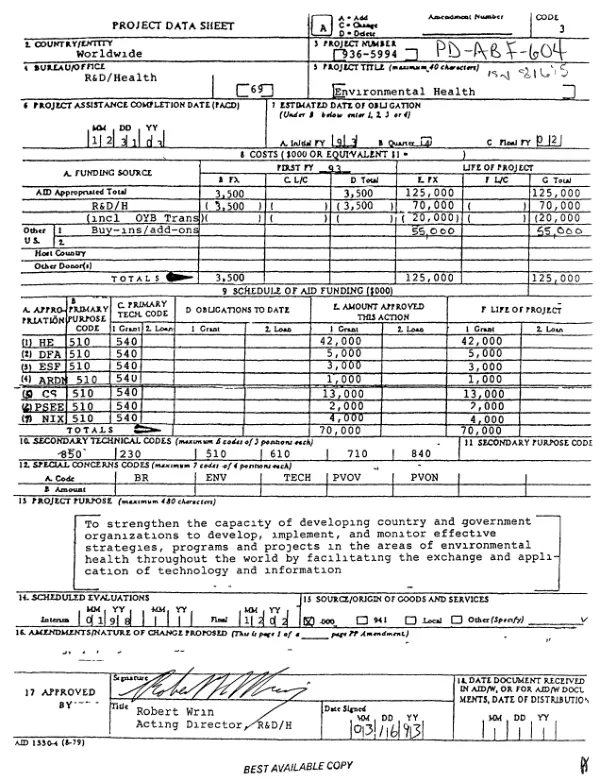
Abstract
The 10-year project, a follow-on to the Water and Sanitation for Health (WASH) and the Vector Biology and Control (VBC) Projects (Nos. 9365973 and 9365948), will continue to address their foci of water supply/sanitation and tropical diseases, while also incorporating issues in air pollution, food hygiene, hazardous materials, occupational health, and accidental injury. The project will be implemented by a U.S. contractor. The project will provide TA in nine areas: engineering and technology, institutional and human resource development, policy, public health, community participation, information services, epidemiology, finance, and health and management information systems. Assistance will be provided to organizations at the national, regional, and community levels. There are six main planned outputs. (1) The project will improve the design, implementation, and evaluation of EH activities in ten countries by providing TA and workshops for host governments and local NGOs in the preparation of sector assessments and EH plans, the development and implementation of EH policies, and development of an EH projects database. (2) To strengthen personnel skills, the project will provide TA to 1,000 developing country professionals and staff, 40-50 developing country programs, 4-6 training centers, and 10-15 research institutions, and assist in the development of training programs and educational materials. (3) To improve the management and cost-effectiveness of EH institutions, the project will assist 40-50 EH programs in applying appropriate technologies, assessing EH risks, and designing and evaluating EH projects. (4) To increase community health education and involvement and to promote changes in personal behavior to reduce EH risks, the project will work in ten countries to develop community health committees, water user associations, and community environmental management organizations; assist with community participation activities; develop behavioral change activities; and develop and expand women"s networking and leadership skills in relation to EH. (5) Activities to improve long-term financial planning for operations and maintenance in EH will be conducted in 20 countries and will include willingness-to-pay and gender impact studies, life cycle cost analyses, and efforts to integrate finance and cost recovery aspects into EH programs. (6) Finally, the project will work in 30 countries to facilitate the involvement of the private sector, including NGOs, in EH.