USAID. BUR. FOR AFRICA. REGIONAL ECONOMIC DEVELOPMENT SERVICES OFC. (REDSO) WEST AND CENTRAL AFRICA
Family health and AIDS
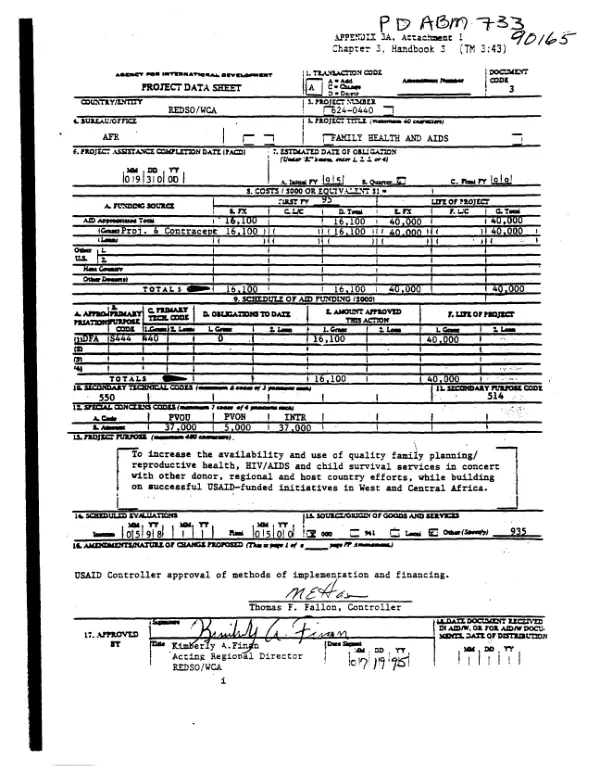
Project to increase the availability and quality of family planning (FP), AIDS, and maternal/child health (MCH) care in West and Central Africa.
1995
Sign in to readA free account is required to download.
Abstract
The project will include a service delivery component, to be implemented in 3-4 countries where USAID Missions have recently closed, and 3 regional components: information, education, and communication (IEC); training; and operations research. Activities will be implemented through cooperative agreements with U.S. PVOs, in close collaboration with other donors, local participants, and remaining USAID bilateral activities. The service delivery component will improve the delivery of low-cost, integrated FP, AIDS, and to a lesser extent, MCH care in 3-4 countries (likely candidates are Burkina Faso, Cameroon, Cote d"Ivoire, and Togo) through strengthened linkages among social marketing programs, community organizations, and public and private health delivery systems. While specific activities will be based on local needs and capacity, in general this component will focus on: (1) prevention of health problems that will cross borders into other countries in the region; (2) cost-effective strategies, such as selective integration of services; regional, national, and other-donor partnerships; and use of a best practices methodology; and (3) capacity building and sustainability, through local participation, training, and information exchange. The project will support a partnership program among social marketing, community-based, and health facility-based interventions. With regard to community- and health facility-based interventions, the project will use a best practices methodology to strengthen existing service delivery skills, with emphasis on institutionalizing host country training capacity, e.g., by training trainers and developing training materials. This component will also support policy dialogue with host country governments, donors, and African institutions, and will improve management and procedural support systems. The project will ensure adequate contraceptive supply by providing $4 million worth of condoms and other contraceptives. The IEC component will support a partnership between a U.S. organization and appropriate African organizations to: develop a regional strategy for cost-effective implementation of project-supported IEC/counseling activities; develop IEC/counseling guidelines and materials; develop IEC networks to disseminate regional experiences and share expertise; and provide demand-driven TA, using primarily African consultants. The training component will support a partnership between U.S. and African institutions to develop regional and national training strategies and will provide African partners with TA for management and organizational development. This component will contribute to the development of a computerized database of African expertise, and to upgrading the skills of African consultants. The operations research component will fund a partnership between U.S.-based and African institutions and consultants for: development of a common regional research agenda; analyses of secondary data; TA and funding for multi-country and multi-locational studies; strengthening Centers of Excellence for operations research, and design and testing of mechanisms for donor and national collaboration. Research issues that the project is likely to address include: means of service integration, health financing, community-based distribution of contraceptives, private sector-public sector relationships, and donor coordination.
![USAID/family health and AIDS [FHA] project : project modification activity, March 12-23, 2001 -- final report](https://covers.devme.ai/gen/74256.webp)
![FLAS/[HOPE] HIV AIDS prevention project](https://covers.devme.ai/gen/24881.webp)
![AIDS communications and technical services (ACTS) (supplement) [: amendment no. 1] -- phase two plan of activities](https://covers.devme.ai/gen/29655.webp)