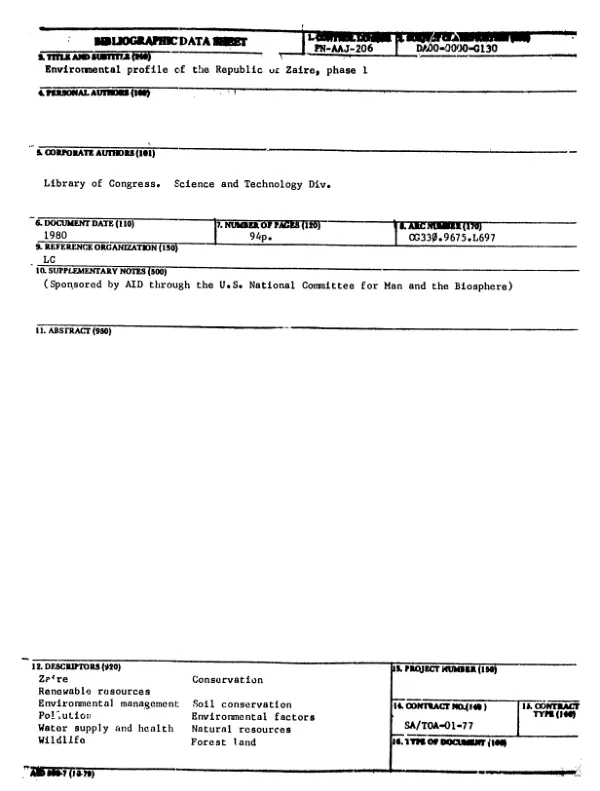
U.S. LIBRARY OF CONGRESS. SCIENCE AND TECHNOLOGY DIV.
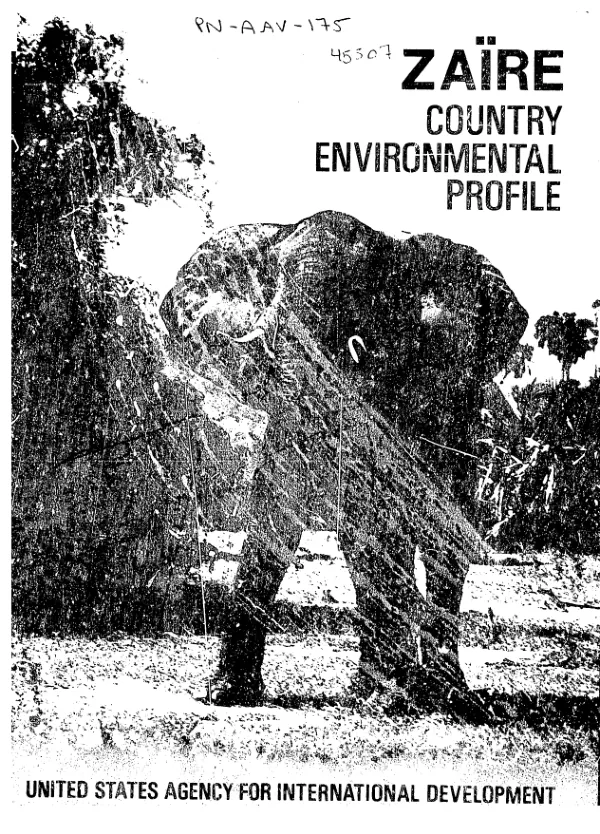
ENVIRONMENTAL PROFILE OF THE REPUBLIC OF ZAIRE, PHASE 1
Because of its slow economic and population growth, Zaire"s natural resource base is not under serious assault.
1970
Sign in to readA free account is required to download.
Abstract
With forested areas remaining largely intact, pressure on other renewable natural resources can be managed in the short term. Zaire thus has the advantage of anticipating rather than reacting to potential problems. Nevertheless, from a micro point of view, it is already experiencing significant environmental problems around the periphery of its urban centers. This draft report discusses both of these perspectives while profiling Zaire"s water, soil, forestry, and wildlife resources. An overview of the nation"s physical, demographic, economic, and social characteristics as well as national park and reserve data is also provided. Population density, which is low nationally, is high in such urban centers as Kinshasa. Inadequate local sanitation facilities and limited water supplies, compounded by the lack of a national sewerage system, have created hazardous health conditions in these centers, where an estimated 25% of Zaire"s population resides. In 1974, only 25% of the city dwellers had access to piped water. Pollution created by mining industries located in Eastern and Southeastern Zaire has increased. Offshore oil exploration and production in Bas-Zaire is a potential evironmental concern. The pollution of surface and groundwaters by industry, as witnessed at Lake Kivu, is also becoming widespread. Rural areas must obtain water supplies from unprotected natural water sources, which encourage the spread of insect- and rodent-borne diseases. The newly established Service de l"Environnement is working to control industrial pollution and improve basic sanitary conditions. Unfortunately, Zaire lacks a comprehensive legislative framework for pollution control and little information is available concerning the responsibilities of the nation"s environmental organizations. Seven appendices which provide supporting data and a 55-item bibliography (1944-79) in English, German, and French are appended.
Related documents