U.S. LIBRARY OF CONGRESS. SCIENCE AND TECHNOLOGY DIV.
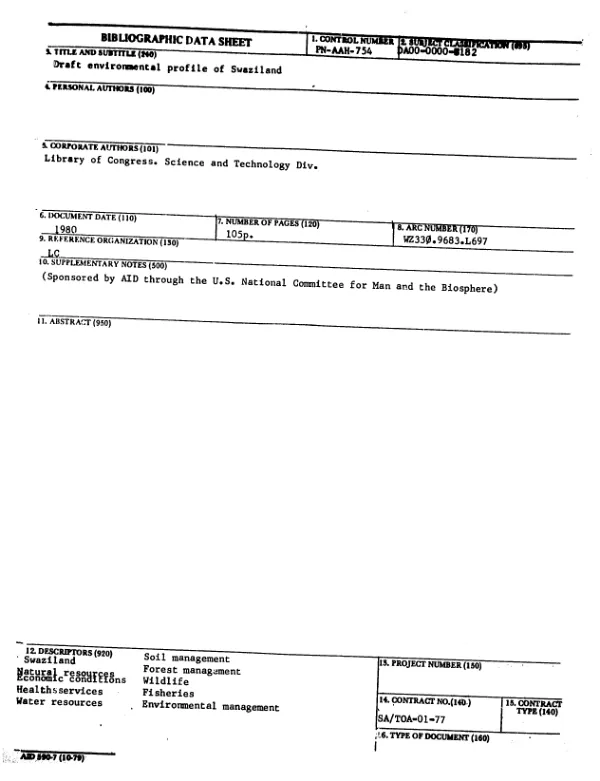
Draft environmental profile of Swaziland
Swaziland is a nation with both abundant natural resources and serious environmental problems.
1970
Sign in to readA free account is required to download.
Abstract
This report assesses Swaziland"s environment after first presenting an extensive overview of the topography, health, education, climate, religion, and economy of this landlocked nation. Five main problems burden the natural environment. The first, deterioration of arable and communal grazing lands, has two main causes: overstocking of livestock, and the fact that much of the arable land is on steep slopes, making it prone to erosion. To remedy this, destocking programs combined with crop development programs are recommended. Mandatory strip cultivation, contour plowing, and cultivation over 100 feet from river banks are also required. The second problem, the high incidence of waterborne diseases such as bilharzia, is especially common in the many surface water and irrigated areas of Swaziland. Major programs to eradicate these diseases include eliminating the host snail population and providing clean water and sanitary facilities. Because the expanding activities of a growing population alter the natural environment -- the third problem -- strong national development planning is needed to conserve plants and animals in their natural ecosystems. To this end, the National Trust Commission has been established and 31 sites designated for nature reserves. A fourth problem, rapid urbanization, has led to shelter and environmental health problems due to inaccessible potable water and sanitation facilities, especially in squatter settlements on the urban fringe. In some cases, building these settlements has been prohibited around endangered watersheds, but physical planning and environmental controls are still needed around urban centers. The final problem, Swaziland"s high rate of population growth (3.0 to 3.2%), places great pressure on land resources. The Government is attempting to deal with this problem through maternal and child health/family planning programs. Attached are technical appendices, a 38-item bibliography (1961-79), and a list of organizations and legislation relevant to natural resource management.