ANOVA HEALTH INSTITUTE
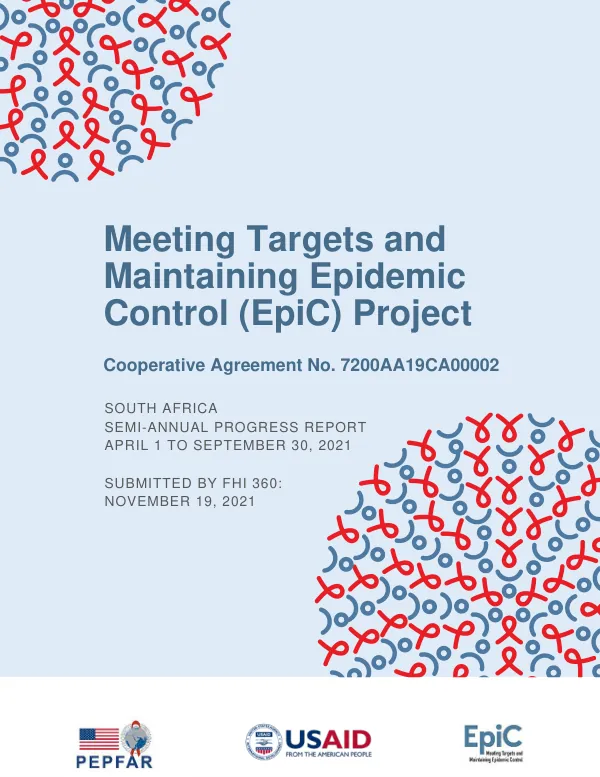
EpiC Semi-Annual Report (FY21 Q3-Q4 April to September 2021) – South Africa
The EpiC program in South Africa, implemented by FHI 360, focused on two key activities: the Key Populations (KP) program and the HIV care and treatment program implemented by John Snow Inc (JSI).
2021 · 31 pages
Sign in to readA free account is required to download.
Abstract
The KP program targeted men who have sex with men (MSM) and was implemented in partnership with two implementing partners, Anova Health Institute and OUT LGBT Wellbeing's Engage Men's Health program, working in five districts in three provinces in South Africa. The KP program aimed to mitigate the impact of HIV among MSM by reaching them for HIV testing, linkage to care, ART initiation, adherence to treatment, and viral load (VL) suppression, as well as increasing PrEP uptake. Innovative approaches such as Enhanced Peer Outreach Approach (EPOA), mapping of hotspots, Risk Network Referral (RNR), and risk segmentation of the MSM population were introduced to address gaps in the HIV cascade. The program continued to implement Key Population Investment Fund (KPIF) activities that complemented country operational plan (COP) programming, supporting main IPs and community-based organizations (CBOs) to improve uptake of HIV testing services and HIV case finding. Significant progress was made towards reaching annual PEPFAR targets for FY21, with a shortfall in case finding rate at 6.1%. However, the program surpassed KP_PREV and HTS_TST targets and achieved more than 95% of the HTS_POS, TX_NEW, and PREP_NEW targets. The main focus of sub-partners, including KPIF-funded CBOs, was to improve case finding through scale-up of targeted testing modalities such as EPOA and index testing, and to improve initiation rates and retention across the HIV cascade. The program reached 16,119 MSM with HIV prevention interventions, cumulatively reaching 110.5% of the annual target. A total of 12,609 MSM were tested for HIV through HTS services and received their results, achieving 129.2% of the overall annual target. Of the MSM tested, 637 tested positive for HIV and received their results, contributing to 98.8% achievement against the annual target and reaching a case finding rate of 6.1%. The overall ART linkage rate was 95% for this period, and 2,873 MSM were retained on ART treatment within EpiC sites by the end of Q4, achieving 100.3% of the overall FY21 target. The Complementing HIV Care and Treatment Service Delivery for the City of Johannesburg Program, implemented by JSI, concluded its technical activities on June 30, 2021. Despite the limited implementation timeline, Department of Health (DoH) stakeholders recognized the benefits of JSI's facilitated online training and index testing practices, which produced positive results not only in Sub-district E but also in the whole of Johannesburg Health District. The EpiC program in South Africa made significant progress towards reaching annual PEPFAR targets for FY21, with a focus on improving case finding, initiation rates, and retention across the HIV cascade. The program reached a large number of MSM with HIV prevention interventions, tested a significant number of MSM for HIV, and achieved high rates of ART linkage and retention. The program's innovative approaches and partnerships with CBOs and IPs contributed to its success in achieving FY21 annual PEPFAR targets. The program's achievements in reaching MSM with HIV prevention interventions, testing MSM for HIV, and achieving high rates of ART linkage and retention demonstrate its effectiveness in mitigating the impact of HIV among MSM in South Africa. The program's focus on improving case finding, initiation rates, and retention across the HIV cascade is critical to achieving epidemic control among Key Populations in South Africa. The EpiC program's success in South Africa is a testament to the importance of investing in programs that target Key Populations, particularly MSM, who are disproportionately affected by HIV. The program's innovative approaches and partnerships with CBOs and IPs have contributed to its success in achieving FY21 annual PEPFAR targets and demonstrate the potential for similar programs to make a significant impact in other settings.