CENTER FOR EDUCATIONAL DEVELOPMENT
South Africa School-Based Sexuality and HIV Prevention Education Activity
The South Africa School-Based Sexuality and HIV Prevention Education Activity is a USAID-funded program aimed at reducing new HIV infections among students and teachers by assisting the Department of Basic Education (DBE) in implementing high-quality, evidence-informed sexuality and HIV prevention education.
2019 · 19 pages
Sign in to readA free account is required to download.
Abstract
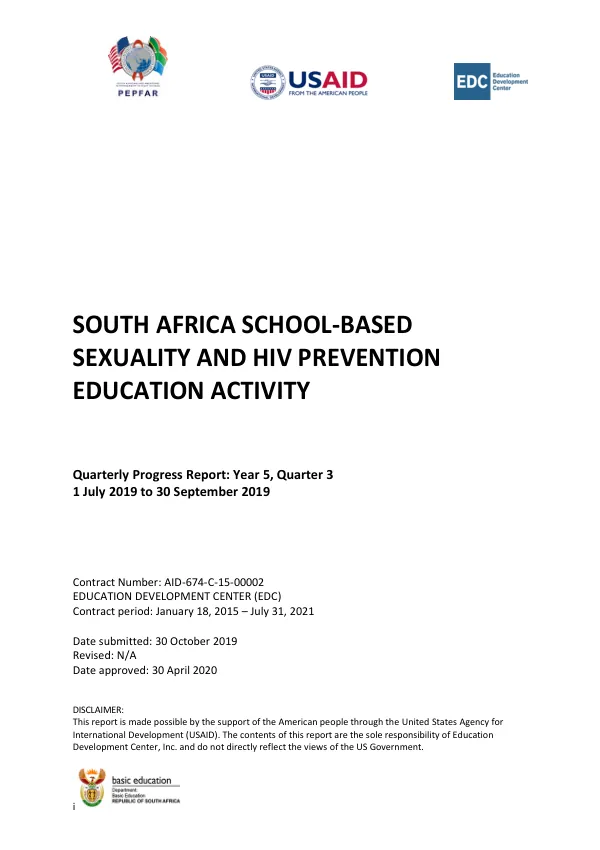
The program focuses on five provinces with the highest HIV infection rate and burden, including Gauteng, Free State, Mpumalanga, KwaZulu Natal, and Western Cape. During the July to September 2019 reporting period, the program achieved several major achievements. These include conducting mop-up training of educators, School Governing Boards (SGBs), and School Management Teams (SMTs) in all five provinces. The training focused on the FET phase, as the Activity is struggling to reach this age group. Additionally, the program conducted quarterly meetings to provide progress updates and plan with the provinces, and responded to questions from the media on Comprehensive Sexuality Education (CSE) content and implementation. The program also developed and reviewed the Integrated Package (IP) and FET age-appropriate posters, which were reviewed and approved by the OGAC expert. The posters were designed to provide information necessary for the safety of relevant age groups. Furthermore, the program attended a DREAMS camp with DREAMS Ambassadors, which aimed to empower them with leadership and communication skills. The program's objectives include increasing the number of teachers qualified to teach sexuality education, strengthening DBE's capacity to provide education and training for teachers, and improving the quality of school-based sexuality and HIV education programs. The program also aims to increase DBE's capacity to work in partnership with the Department of Health to implement the Integrated School Health Program, reduce teenage pregnancy, and increase the retention of girls in school. The program has made significant progress in achieving its objectives, with major achievements including the training of educators, SGBs, and SMTs in all five provinces, and the development and review of the IP and FET age-appropriate posters. The program has also strengthened linkages to health services in Gauteng, Free State, KwaZulu Natal, and Mpumalanga, and collected and reported implementation data from all provinces. The program's implementation focus is on five provinces, including Gauteng, Free State, Mpumalanga, KwaZulu Natal, and Western Cape, which have the highest HIV infection rate and burden. The program's target districts include Thabo Mofutsanyane in the Free State, Johannesburg West in the City of Johannesburg in Gauteng, King Cetshwayo, Umlazi, and Pinetown in KwaZulu Natal, Ehlanzeni, Nkangala, and Gert Sibande in Mpumalanga, and City of Cape Town in the Metro North and Metro East in the Western Cape. The program's progress towards performance indicators includes the training of educators, SGBs, and SMTs in all five provinces, and the development and review of the IP and FET age-appropriate posters. The program has also strengthened linkages to health services in Gauteng, Free State, KwaZulu Natal, and Mpumalanga, and collected and reported implementation data from all provinces. The program's lessons learned and recommendations include the importance of strengthening linkages to health services, improving the quality of school-based sexuality and HIV education programs, and increasing DBE's capacity to work in partnership with the Department of Health to implement the Integrated School Health Program. The program also recommends increasing the number of teachers qualified to teach sexuality education, and improving the quality of school-based sexuality and HIV education programs. The program's financial reporting and procurement expenditures include the expenditure of $1,234,567 for the July to September 2019 reporting period. The program's operations and management include the management of the program by the Education Development Center, Inc. (EDC), and the support of the program by the Department of Basic Education (DBE) and the Department of Health. The program's list of upcoming activities and next steps includes the implementation of the program in the remaining provinces, the strengthening of linkages to health services, and the improvement of the quality of school-based sexuality and HIV education programs. The program's annexes include Annex A: The South Africa School-Based Sexuality and HIV Prevention Education Activity Results Framework, and Annex B: Activity Staff as of 30 September 2019.