USAID. BUR. FOR NEAR EAST. OFC. OF REGIONAL AFFAIRS
Epidemiology of arthropod-borne diseases
Project to initiate complementary research in Egypt and Israel to characterize the epidemiology of, and develop scientifically based control strategies for, 3 arthropod-borne diseases - Rift Valley Fever (RVF), malaria, and leishmaniasis - threatening human populations.
1981
Sign in to readA free account is required to download.
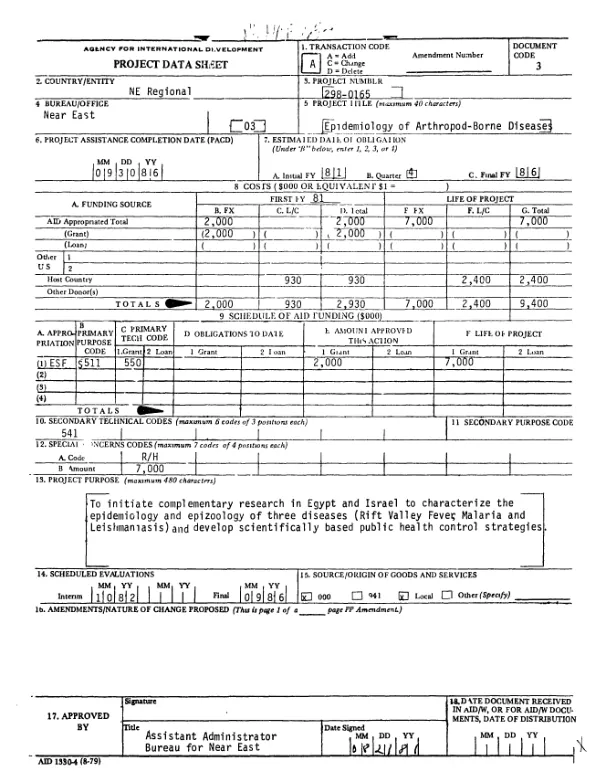
Abstract
The U.S. National Institutes of Health will coordinate the project and subcontract research to two universities - Ain Shams (Cairo) and Hebrew (Jerusalem). The project will establish a system of field facilities to study the entomological and epidemiological aspects of the three diseases. The facilities will include a fixed field station in the Sinai and mobile field laboratories in Israel and Egypt. The Egyptian mobile team will place special stress on the Sudan border and the area of Lake Nasser; the Israeli team will focus efforts on the Sinai border and in the Negev desert. Efforts in year 1 will include a surveillance program to document the occurrence of the diseases in humans and serological surveys in all populated areas of Egypt and Israel, followed by a wide range of serological tests aimed at isolating disease vectors. Entomological studies to identify potential disease vectors will also be conducted. In years 2-4, the project will conduct: (1) longitudinal serological and parasitological surveys on human populations at risk in order to chart the seasonality of infection and general epidemiological parameters; (2) animal surveys to determine infection with RVF virus or leishmania in reservoir hosts; and (3) field and laboratory entomological studies aimed at precisely characterizing vector species via longitudinal studies of population dynamics, vector competence, genetics, cytogenetics, and susceptibility to insecticides. Two or three sites will be chosen for intensive study of the ecological interrelationships affecting disease maintenance and spread. In year 5, research results will be used to develop rational and economically, geographically, and biologically feasible control schemes aimed at regulating the three diseases. The project will also provide training and support opportunities for young Egyptian and Israeli technicians, graduate students, and postdoctoral research associates.