USAID DEC
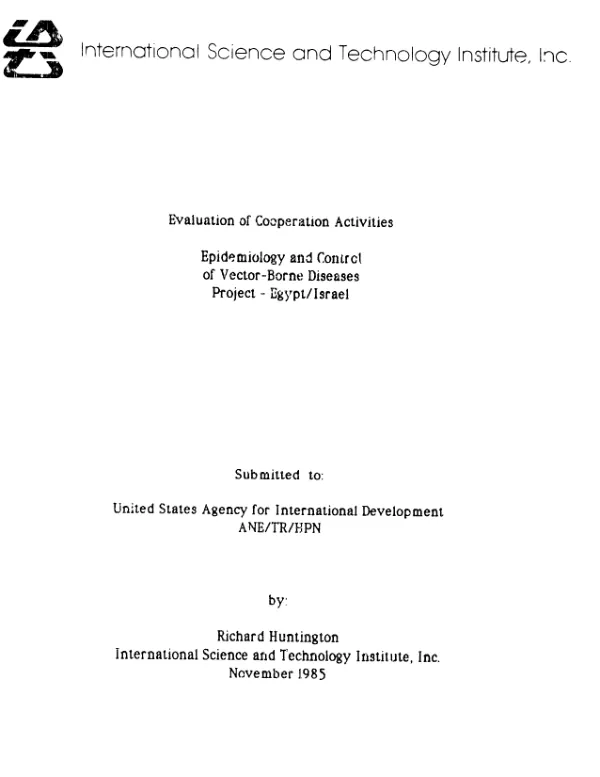
Report by external scientific committee on NIAID research contracts no. 1-A1-22667/8 : epidemiology and control of vector-borne diseases in Egypt and Israel
Sign inUSAID. BUR. FOR ASIA AND NEAR EAST
Report by external scientific committee on NIAID research contracts no. 1-A1-22667/8 : epidemiology and control of vector-borne diseases in Egypt and Israel
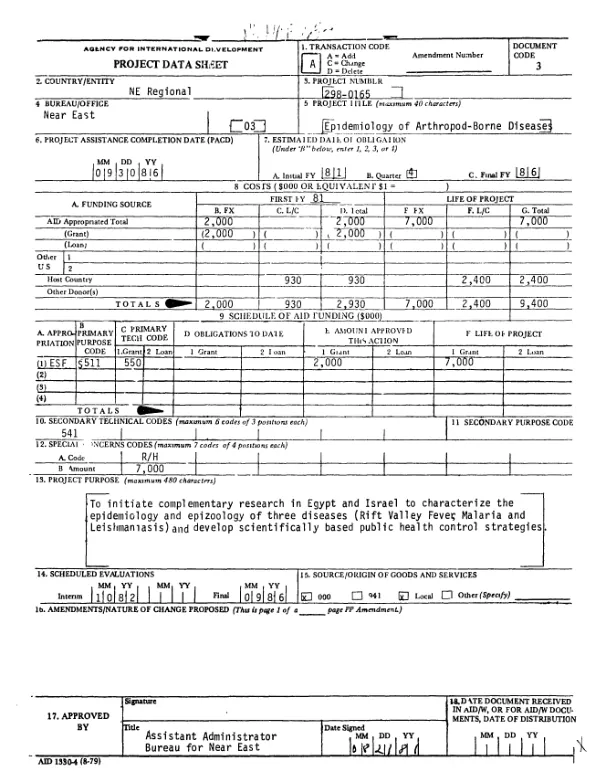
Evaluates cooperative project between Isreal's Hebrew University and Egypt's Ain Shams Universty to conduct research on the epidemiology and control of 3 arthropod-borne diseases - malaria, Rift Valley fever, and leishmaniasis.
1985
Sign in to readA free account is required to download.
Abstract
External evaluation covers the period 1981-9/85 and is based on document review, interviews with scientists, and site visits. Research has evolved over the 4 years with steady improvement in facilities, scientific quality, and cooperation, and, relative to other activities in each country, is strong. Leishmaniasis research has been outstanding, notably in the discovery of foci of visceral and cutaneous disease and the discovery of Leishmania major infection in dogs and rodents. Malaria research in Israel has also been strong, focusing on the development of diagnostic tools, immunity studies, and parasite physiology, as malaria occurs there only when introduced. No cases of Rift Valley fever have been detected in Egypt since 1981, but surveillance has identified other viral illnesses, such as sandfly fever. Sandfly biology and ecology studies have been excellent, reflecting a high level of entomological competence. Filariasis research was added in 1984. Positive project results are partly attibutable to the use of cost reimbursement, which has allowed close monitoring of project activities. Weak points include slow progress in Egyptian efforts to develop longitudinal epidemiological malaria studies and lack of promise in Israeli studies to define the mosquito fauna and its biology in the Negev. Both Egyptian and Israeli students working with the project (6 at the Ph.D., 38 at the M.Sc., and 9 at the undergraduate and technical levels) are bright and enthusiastic and the training environment is excellent (several Ph.D. students have made significant publications). Six meetings have taken place among scientists, but students have played a small part in regional cooperation. It is recommended that the project be renewed, with (1) additional U.S. personnel assigned in parasite immunodiagnosis and in the biohazard aspects of virology and (2) emphasis on leishmaniasis and rapid diagnostic procedures.