CLOUDBURST CONSULTING GROUP, INC.
ERC Quarterly Report (April 1– June 30, 2014)
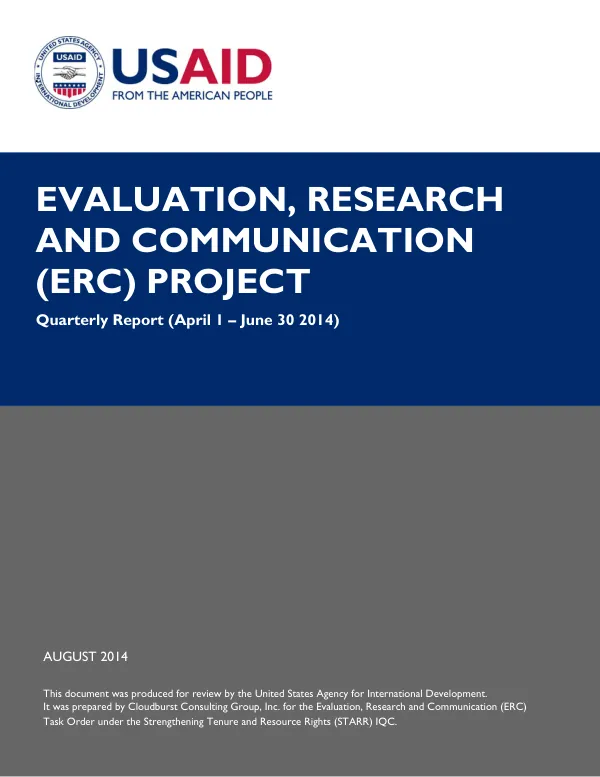
The Evaluation, Research and Communication (ERC) project is a five-year task order beginning in May 2013, under the USAID Strengthening Tenure and Resource Rights (STARR) Indefinite Quantity Contract.
2014 · 46 pages
Sign in to readA free account is required to download.
Abstract
The purpose of ERC is to provide evidence-based knowledge around best practices in land tenure and property rights (LTPR). ERC supports USAID's Climate Change and Development Strategy, focusing on improving land-use planning to reduce deforestation and reducing conflict. ERC employs a multidisciplinary approach, aligning with USAID Forward principles of learning and evidence-based programming. The project includes five task areas: impact evaluation, research, training, research, and training of USAID and partners in LTPR principles and programming approaches. The quarterly report for April 1– June 30, 2014, highlights the project's progress and learnings. Work during this quarter focused on developing strategies and action plans for the upcoming year, as well as ramping up field-based activities. Efforts were made to refine the approach to impact evaluation and strengthen collaboration with implementing partners. Task 1, 2, and 5 activities are underway, with initial project design work and peer-review procedures being developed. Task 5 activities involved traveling to Burkina Faso and Tanzania to engage with government actors, civil society, and local organizations. Tasks 3 and 4 focused on strategic planning and creating action plans to move the LTD's agenda forward. A new communications plan was finalized and submitted, and a targeted effort related to the PRADD project was developed. The project also continued to support the LTD's global engagement, including the observance of the Voluntary Guidelines and the Responsible Agricultural Investments negotiations. The degree and scope of collaboration with other actors, particularly STARR partners, are notable in this quarter's activities. ERC sent staff to Burlington, Vermont, to collaborate with Tetra/ARD implementers for the PRADD project. The project also engaged with government actors, civil society, and local organizations in Burkina Faso and Tanzania. The quarterly report highlights the project's progress and learnings, including the development of a procedure for peer-review procedures for impact evaluation design documents. The project also identified the need to better match work visits and engagement with implementing partners to use technology for data collection in the field. The report also mentions the importance of building knowledge across STARR partner organizations and the need to identify the best ways to use technology for data collection in the field. The project's focus on improving land-use planning to reduce deforestation and reducing conflict is also highlighted. The quarterly report concludes by emphasizing the project's commitment to evidence-based programming and its focus on improving land tenure and property rights. The project's progress and learnings will inform future activities and will continue to support USAID's Climate Change and Development Strategy.