FHI 360
Meeting Targets and Maintaining Epidemic Control (EpiC) Project
The Meeting Targets and Maintaining Epidemic Control (EpiC) Project is a global cooperative agreement dedicated to achieving and maintaining HIV epidemic control.
2020 · 3 pages
Sign in to readA free account is required to download.
Abstract
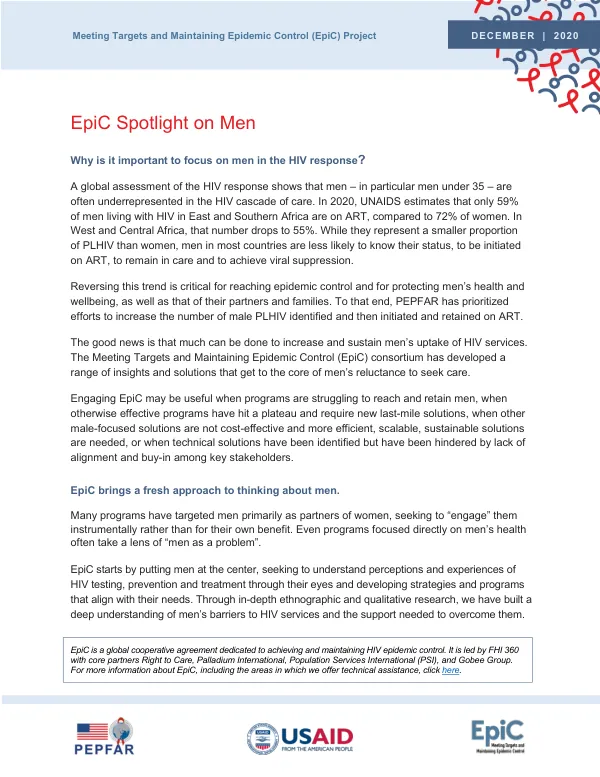
Led by FHI 360, the project brings together core partners Right to Care, Palladium International, Population Services International (PSI), and Gobee Group to address the HIV response. A key focus of the project is on men, who are often underrepresented in the HIV cascade of care. In 2020, UNAIDS estimates that only 59% of men living with HIV in East and Southern Africa were on antiretroviral therapy (ART), compared to 72% of women. In West and Central Africa, the number drops to 55%. The EpiC project has developed a range of insights and solutions to increase and sustain men's uptake of HIV services. The project's approach is centered on understanding men's perceptions and experiences of HIV testing, prevention, and treatment through their own eyes. This is achieved through in-depth ethnographic and qualitative research, which has built a deep understanding of men's barriers to HIV services and the support needed to overcome them. The project's approach is rooted in deep stakeholder engagement, involving men as well as implementers, funders, government, and other relevant actors in a process of co-creation. EpiC has identified several challenges in reaching and retaining men in HIV services, including misperceptions or lack of understanding about why men are not showing up for services, existing programs and services not reaching or retaining men in sufficient numbers, and stigmatizing beliefs about HIV and ART keeping men from accessing services. To address these challenges, EpiC offers technical assistance and solutions, including validating and contextualizing existing insights on men and HIV, facilitating stakeholder interpretation and application of those insights, and supporting the design of communications strategies, campaigns, and materials that shift the narrative around HIV and ART. In several countries, EpiC has supported the development or revision of strategies, policies, and guidelines that reflect and address men's barriers and drivers related to HIV testing, prevention, and treatment. The project has also supported the adaptation and scaling of effective models for reaching men, such as the Coach Mpilo model, which employs men stable on treatment as coaches of men experiencing barriers to linkage and adherence. Additionally, EpiC has helped engage critical stakeholders in a co-creation process that builds shared understanding and commitment, ensuring that solutions are acceptable, feasible, and scalable. The EpiC project has made significant progress in addressing the HIV response among men, particularly in countries such as South Africa, Malawi, and Zimbabwe. The project's approach has been instrumental in shifting the way stakeholders think about reaching men, from punitive and rooted in misreading men as stubborn and apathetic to a more empathetic lens that reveals the deep fear and anticipation of loss that characterize many men's emotional response to HIV. The project's work has also led to the development of male-friendly strategies, policies, and guidelines that support men's access to HIV services. The EpiC project is made possible by the generous support of the American people through the United States Agency for International Development (USAID) and the U.S. President's Emergency Plan for AIDS Relief (PEPFAR). The contents of the report are the responsibility of FHI 360 and do not necessarily reflect the views of USAID, PEPFAR, or the United States Government.