USAID DEC
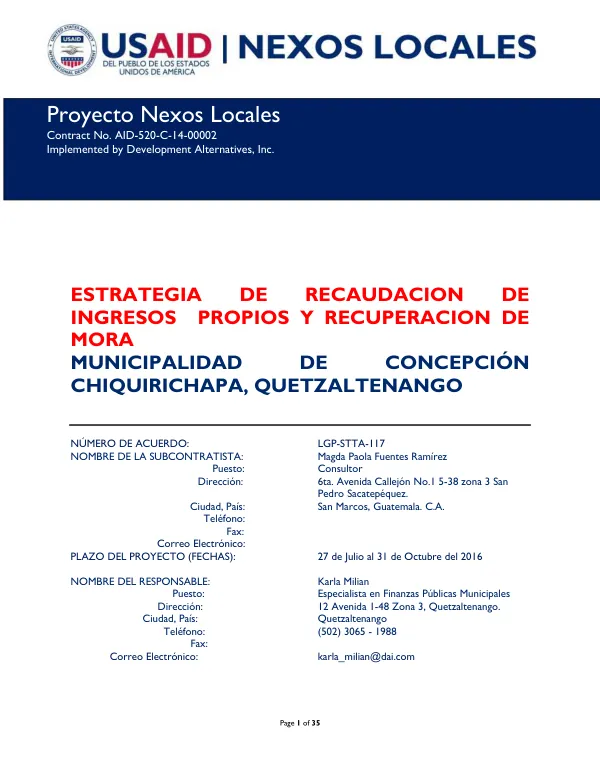
Estrategia de Recaudación de Ingresos Propios y Recuperación de Mora Municipalidad de Concepción Chiquirichapa, Quetzaltenango
Sign inDEVELOPMENT ALTERNATIVES, INC./FINNET
Estrategia de Recaudación de Ingresos Propios y Recuperación de Mora Municipalidad de Concepción Chiquirichapa, Quetzaltenango
The municipal government of Concepción Chiquirichapa, Quetzaltenango, Guatemala, faces significant challenges in terms of low tax revenue collection.
2016 · 35 pages
Sign in to readA free account is required to download.
Abstract
This is a major issue affecting the country's macroeconomic indicators, with both the central government and local governments struggling to meet their financial obligations. To address this problem and provide a framework for improving the situation, the Nexos Locales project developed a technical assistance program to support the municipal government's financial management. The program's main objective is to increase the municipality's own revenue through the collection of decreed municipal taxes and the imposition of fair and equitable fees for public services. This will enable the municipality to finance its operations and infrastructure projects, reducing its reliance on external funding and debt. The program also aims to promote a culture of tax compliance among the local population and to establish a functional revenue collection plan based on clear criteria. The implementation of the revenue collection strategy is focused on several key areas, including the willingness of local authorities to implement the necessary measures, compliance with the principle of legality, the technical capacity of the municipal government, the availability of up-to-date and unified records of taxpayers, and the promotion of a culture of tax compliance among the local population. The program's analysis of the municipal government's revenue potential for 2015 and 2016 identified several key areas for improvement, including the collection of fees for public services such as water and sanitation, the imposition of taxes on property and businesses, and the sale of goods and services. The program also identified the need to increase the municipality's own revenue, which currently accounts for only 5% of the total revenue collected. To address these challenges, the program recommends several strategies, including the establishment of a clear and functional revenue collection plan, the implementation of a culture of tax compliance among the local population, and the promotion of a culture of transparency and accountability within the municipal government. The program also recommends the establishment of a unit within the municipal government responsible for directing the revenue collection process and the implementation of measures to reduce tax evasion and non-compliance. The program's recommendations are based on a thorough analysis of the municipal government's revenue potential and the identification of key areas for improvement. The program's implementation is expected to have a positive impact on the municipality's financial situation, enabling it to increase its own revenue and reduce its reliance on external funding and debt. The municipal government of Concepción Chiquirichapa has identified several key areas for improvement in terms of revenue collection, including the collection of fees for public services, the imposition of taxes on property and businesses, and the sale of goods and services. The program's analysis of the municipal government's revenue potential for 2015 and 2016 identified several key areas for improvement, including the collection of fees for public services such as water and sanitation, the imposition of taxes on property and businesses, and the sale of goods and services. The municipal government of Concepción Chiquirichapa has a significant opportunity to increase its own revenue through the collection of decreed municipal taxes and the imposition of fair and equitable fees for public services. The program's recommendations are designed to support the municipal government in achieving this goal, by establishing a clear and functional revenue collection plan, promoting a culture of tax compliance among the local population, and reducing tax evasion and non-compliance.