CHEMONICS
Estructura Ecológica Principal CORPOGUAJIRA
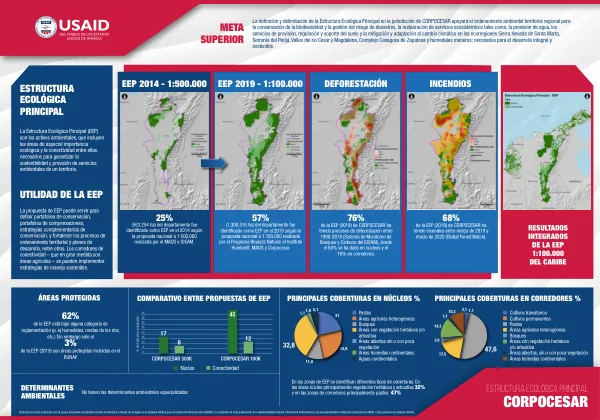
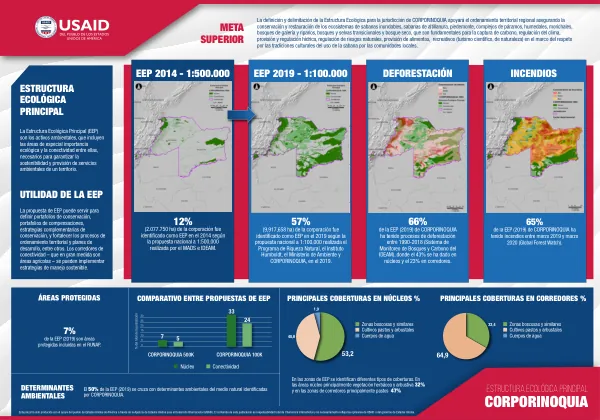
The Estructura Ecológica Principal (EEP) is a critical component of environmental conservation, encompassing essential natural assets, including areas of special ecological importance and connectivity between them, necessary to ensure the sustainability and provision of environmental services in a territory.
2020 · 1 pages
Sign in to readA free account is required to download.
Abstract
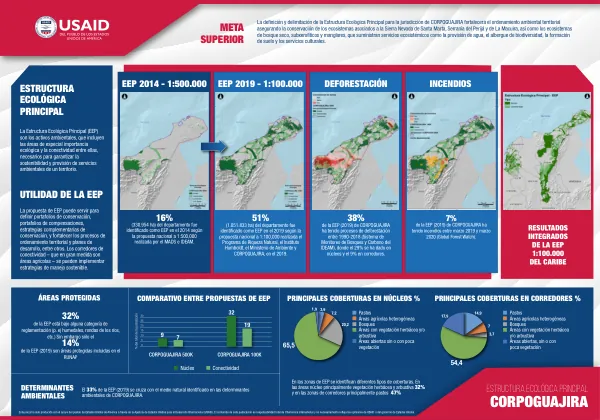
The EEP can serve as a framework for defining conservation portfolios, compensation portfolios, complementary conservation strategies, and strengthening territorial planning and development processes. In the context of CORPOGUAJIRA, the EEP 2019 proposal identified 51% of the department's area, approximately 1,051,833 hectares, as EEP at a 1:100,000 scale. This proposal was developed by the Programa de Riqueza Natural, the Instituto Humboldt, the Ministerio de Ambiente, and CORPOGUAJIRA in 2019. In contrast, the 2014 proposal at a 1:500,000 scale identified 16% of the department's area, approximately 330,954 hectares, as EEP. The EEP 2019 in CORPOGUAJIRA has faced significant environmental challenges, including deforestation and fires. According to the Sistema de Monitoreo de Bosques y Carbono del IDEAM, 38% of the EEP 2019 area experienced deforestation between 1990 and 2018, with 29% occurring in núcleos and 9% in corredores. Additionally, 7% of the EEP 2019 area experienced fires between March 2019 and March 2020, as reported by Global Forest Watch. The EEP 2019 in CORPOGUAJIRA is primarily composed of areas with herbaceous and arbustive vegetation, covering 32% of the núcleo areas, and pastures, covering 47% of the corredores areas. The EEP 2019 also intersects with the natural environment identified in the determinants of CORPOGUAJIRA, with 33% of the area experiencing this overlap. The definition and delimitation of the EEP 2019 for the CORPOGUAJIRA jurisdiction will strengthen territorial environmental planning, ensuring the conservation of ecosystems associated with the Sierra Nevada de Santa Marta, Serranía del Perijá, and La Macuira, as well as the ecosystems of dry forests, subxerophytic, and mangrove forests, which provide essential ecosystem services such as water provision, biodiversity hosting, soil formation, and cultural services.