BANK FOR WEST AFRICAN DEVELOPMENT
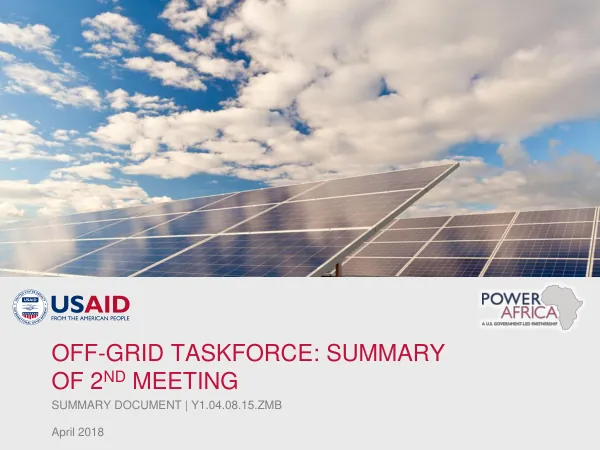
Off-Grid Taskforce: Summary of 2nd Meeting
The Off-Grid Taskforce in Zambia was established to coordinate and oversee market-related initiatives and activities aimed at increasing energy access, particularly in rural areas, in line with government objectives.
2018 · 38 pages
Sign in to readA free account is required to download.
Abstract
The taskforce has adopted three primary objectives: to provide a focus for coordination and oversight of the off-grid sector, to serve as a hub for the exchange and dissemination of experience and information, and to provide a forum for participants to jointly interpret data and identify challenges in the sector. The taskforce structure includes a chair, permanent/core members, and ad-hoc members representing government, private sector, and civil society. The chair is the Vice President, with the Ministry of Energy, Ministry of National Development and Planning, Ministry of Foreign Affairs, Ministry of Commerce Trade and Industry, and Ministry of Community Development and Social Services also represented. Private sector members include representatives from the Solar Industry Association of Zambia, Zambia Renewable Energy Association, bioenergy, financing, and mini-grids. The taskforce has received support from various cooperating partners, including the Department for International Development, Swedish International Development Cooperation Agency, European Union, United States Agency for International Development, and World Bank Group. These partners have provided funding and technical assistance to support the taskforce's objectives. The taskforce has identified several priority areas for intervention, including policy framework, consumer protection and awareness, access to finance, and technical and operational support. Working off the DFID Energy Africa Compact actions, the taskforce has developed a list of 13 proposed priority actions for intervention, including creating off-grid electrification taskforce, subsidizing end-users, conducting economic analysis on job creation and local content strategy, and providing direct financial support to SHS and mini-grid providers. The taskforce has also received support from SAEP, which has developed a list of proposed off-grid taskforce actions, including streamlining the mini-grid licensing procedure, finalizing the renewable energy strategy, and launching a national awareness building campaign. The taskforce has also identified the need for vocational training programs to create a pool of skilled labor and has proposed setting up off-grid specific vocational training programs. The taskforce has made significant progress in its first year, including reviewing and adopting the Terms of Reference, defining the taskforce structure and reporting mechanism, aligning on top taskforce priorities, and deciding on how private-sector players will be represented on the taskforce. The taskforce has also identified short-term and medium-term priorities, including creating off-grid electrification taskforce, subsidizing end-users, and conducting economic analysis on job creation and local content strategy. Overall, the Off-Grid Taskforce in Zambia is playing a critical role in promoting energy access and economic development in the country, particularly in rural areas. The taskforce's objectives and priorities are aligned with government objectives, and its structure and membership ensure representation across key private and public sector stakeholders and civil society.
Related documents